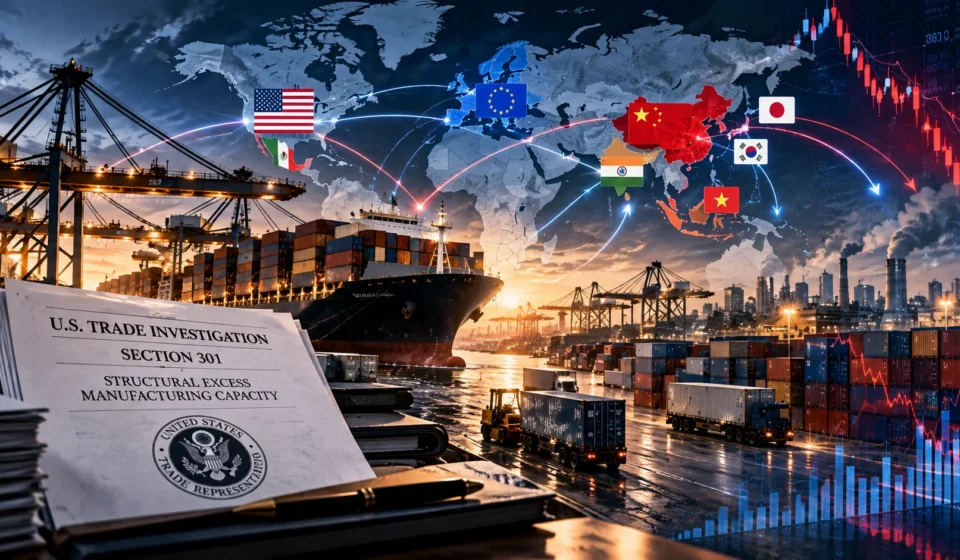

Global trade tensions moved back into the spotlight in March 2026 after the United States launched a new wave of investigations that could eventually lead to additional tariffs on some of the world’s largest economies.
Because if global supply chains, inflation, geopolitical risk and shipping disruptions were not already keeping companies busy enough, tariff uncertainty has now returned to the agenda.
On March 11, the Office of the U.S. Trade Representative opened Section 301 investigations into what it described as structural excess manufacturing capacity and production in multiple foreign markets.
The list was not exactly short.
China, the European Union, Japan, South Korea, India, Mexico, Vietnam, Taiwan and several other major trading partners were included.
In other words, a fairly large portion of the manufacturing world has been invited to Washington’s latest trade-policy conversation.
Why the New Trade Investigations Matter
Section 301 of the U.S. Trade Act gives Washington the authority to investigate foreign policies or practices that may unfairly burden American commerce.
In practical terms, it is one of the legal tools the United States can use before introducing trade measures such as tariffs.
The March investigations focus on what U.S. officials describe as structural manufacturing overcapacity.
The concern is that some countries may be producing more goods than their domestic economies can absorb and then exporting that excess into international markets.
Supporters of the investigation say this can place pressure on American manufacturers.
Critics may respond that producing efficiently and exporting successfully is usually considered a feature of international trade rather than a bug.
And that is where things start getting interesting.
China Is Not the Only Country Under the Microscope
The obvious assumption would be that this is another chapter in the long-running U.S.–China trade dispute.
Not quite.
China is included, but so are the EU, Japan, South Korea, India, Mexico, Vietnam, Taiwan, Singapore, Switzerland, Norway, Indonesia, Malaysia, Cambodia, Thailand and Bangladesh.
That makes this much broader than another Washington–Beijing disagreement.
It is closer to a general review of how global manufacturing works.
Industries potentially affected range from steel and chemicals to electronics, machinery, vehicles and industrial components.
So yes, this one could touch quite a few balance sheets.
Washington Wants More Manufacturing at Home
The U.S. administration says the investigations are part of a wider effort to support domestic industry.
The basic argument is straightforward.
If foreign producers keep expanding capacity faster than local demand, large volumes of goods may end up being exported at prices that American companies struggle to match.
Washington increasingly treats this not only as a trade issue, but also as an industrial-policy and national-security issue.
Semiconductors, vehicles, batteries, pharmaceuticals, energy technology and critical materials are all now considered strategically important.
The era when policymakers simply asked, “Where can we buy this cheapest?” is clearly fading.
The new question is closer to:
“Where is it made, who controls the supply chain, and what happens if that relationship suddenly becomes politically inconvenient?”
So What Exactly Is “Excess Capacity”?
Excess capacity sounds technical, but the idea is fairly simple.
A country has manufacturing capacity beyond what its domestic economy needs.
Some spare capacity is normal.
Factories do not run at exactly 100% every day.
The controversy begins when excess production becomes persistent and leads to very large export volumes.
U.S. officials argue that this can distort international markets.
Countries under investigation may argue that strong exports reflect competitive costs, better infrastructure or higher productivity.
Both sides are unlikely to settle the matter over a friendly coffee.
No, Tariffs Have Not Been Imposed Yet
The launch of a Section 301 investigation does not mean new tariffs begin tomorrow morning.
There is still a process.
Consultations.
Public comments.
Hearings.
More documents.
More meetings.
Probably more meetings about the meetings.
Only after that can the U.S. government decide whether additional measures are justified.
For investors, the important point is that tariff risk has increased even though the final outcome remains uncertain.
Markets often react to the possibility of a policy change long before the policy actually arrives.
Companies Have Seen This Movie Before
Businesses already know what tariffs can do.
They can help domestic manufacturers that compete directly with imported products.
They can also make imported components more expensive.
This creates the classic trade-policy problem.
One company celebrates.
Another company receives a larger supplier invoice.
For example, a tariff on steel may support domestic steelmakers.
Wonderful.
Unless you manufacture cars, appliances, machinery or buildings and need to buy that steel.
Then the celebration becomes slightly less enthusiastic.
Supply Chains May Need Another Redesign
Over the past several years, global companies have already spent enormous amounts of time redesigning supply chains.
First came pandemic disruptions.
Then geopolitical tensions.
Then companies moved production away from China.
Then they discovered that moving production is expensive.
Now some of the alternative manufacturing hubs are also included in U.S. trade investigations.
For multinational companies, the message may feel something like:
“Congratulations on diversifying your supply chain. Please diversify it again.”
Businesses may respond by spreading production across more countries, holding additional inventory or bringing manufacturing closer to customers.
All of those strategies can improve resilience.
None of them are particularly cheap.
Europe Has Joined the Conversation
The European Union is also included in the investigation.
That matters because the U.S. and EU have one of the largest trade relationships in the world.
Potential disputes could affect automobiles, industrial machinery, pharmaceuticals, chemicals and consumer products.
Trade disagreements between Washington and Brussels are especially complicated because economic cooperation sits alongside close political and security ties.
It is entirely possible for two allies to cooperate on defense in the morning and argue about industrial subsidies in the afternoon.
International relations can be efficient like that.
Asian Manufacturing Hubs Face Fresh Uncertainty
Japan, South Korea, Vietnam, Taiwan, Malaysia and Thailand are also important manufacturing centers.
Many global companies shifted production toward these countries in order to reduce dependence on China.
That strategy became known as “China plus one.”
The problem now is that the “plus one” may also be receiving trade-policy attention.
Companies that spent years building alternative supply chains may therefore have to reassess their exposure once again.
India and Mexico Are Not Exempt Either
India and Mexico have both benefited from the global push toward supply-chain diversification.
Mexico has become especially important because of its proximity to the U.S. market.
India has attracted increasing investment in electronics and industrial manufacturing.
Their inclusion shows that the investigation is not only about geopolitical rivalry.
Washington is looking more broadly at global production patterns.
That could make the final outcome much more significant.
Tariffs and Inflation: An Awkward Relationship
Tariffs can support domestic manufacturing.
They can also increase prices.
That combination creates an uncomfortable policy debate.
If imported goods become more expensive, companies may pass those costs on to consumers.
If they do not, profit margins decline.
Either way, somebody pays.
This is why economists often point out that tariffs can behave like a tax on parts of the supply chain.
For central banks already trying to keep inflation under control, another source of price pressure is not exactly a welcome gift.
Corporate Margins Could Feel the Pressure
Businesses dependent on imported components are especially exposed.
If tariffs appear, management teams usually have four choices:
Raise prices.
Accept lower margins.
Find another supplier.
Move production.
None is especially attractive.
And that is why tariff investigations can affect company valuations before a single new duty is officially collected.
Markets price future pain surprisingly efficiently.
Not Every Stock Will React the Same Way
Trade disputes create winners and losers.
Domestic producers may benefit from protection.
Import-dependent manufacturers may suffer.
Retailers may face higher product costs.
Logistics firms may see trade routes change.
Agricultural exporters could become targets if other countries retaliate.
So “tariffs are bad for stocks” is too simplistic.
The real question is:
Bad for which stocks?
The Currency Market May Get Involved Too
Trade policy also affects currencies.
If tariffs reduce imports, trade balances can change.
Periods of uncertainty can also increase demand for the U.S. dollar.
On the other hand, retaliation can hurt American exports.
Currency markets therefore have plenty to process.
And currency traders, famously, enjoy nothing more than additional uncertainty.
Retaliation Could Be the Bigger Story
If the United States eventually introduces new tariffs, trading partners may respond.
That is where a targeted trade measure can become a much broader conflict.
Countries can impose duties on politically sensitive U.S. exports.
Agriculture has often been a popular target in previous disputes.
This means an investigation into industrial manufacturing could eventually affect farmers thousands of miles away.
Global trade has a talent for connecting sectors that originally had absolutely nothing to do with each other.
Globalization Is Not Ending — It Is Getting More Complicated
The broader trend is not the disappearance of globalization.
Goods will still cross borders.
Companies will still manufacture internationally.
Consumers will still buy foreign products.
But globalization is becoming more political.
Companies increasingly consider not only cost, but also geopolitical alignment, national security and regulatory risk.
The vocabulary has changed too.
Friend-shoring.
Near-shoring.
De-risking.
Supply-chain resilience.
All useful ways of saying:
“We would still like global trade, just with fewer surprises.”
Trade Policy Is Becoming Industrial Strategy
Governments increasingly use tariffs and subsidies to influence where strategic industries are located.
Semiconductors are probably the clearest example.
But the same thinking now applies to batteries, vehicles, pharmaceuticals, critical minerals and advanced manufacturing.
The market is therefore becoming less purely market-driven.
Governments want a stronger say in where production happens.
For companies, this means political analysis is becoming almost as important as cost analysis.
What Investors Should Watch
The investigations themselves are only the beginning.
The important questions are what happens next.
Which industries receive the most scrutiny?
Do negotiations resolve some disputes?
Are tariffs eventually imposed?
How do trading partners respond?
Do manufacturers move production again?
And perhaps most importantly:
How much does all of this cost?
Those answers will determine whether the March investigations become a temporary policy story or the beginning of a much larger shift in global trade.
The Bigger Message for Markets
The most important takeaway is not simply that the United States has started another trade investigation.
It is that the rules governing global manufacturing continue to change.
Companies once optimized almost entirely for efficiency.
Now they must optimize for efficiency, security, politics, tariffs and resilience.
Preferably all at the same time.
The new U.S. investigations may ultimately produce negotiations rather than sweeping tariffs.
But the message to international businesses is already clear:
global trade is still open for business — just remember to read the increasingly long terms and conditions.