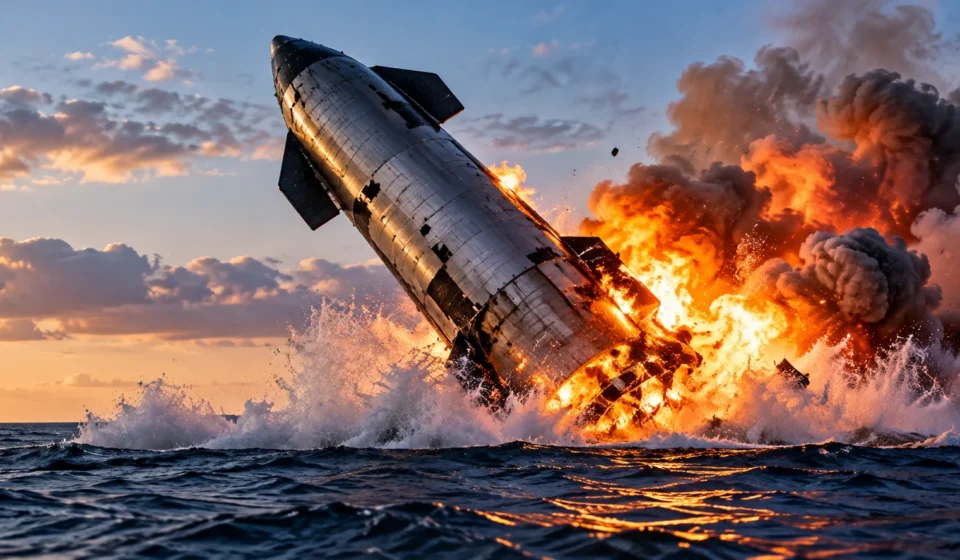
Starship Bursts Into Flames After Splashdown, but SpaceX Still Scores Major Orbital Milestone

SpaceX’s latest Starship mission ended in a spectacular fireball after the spacecraft splashed down in the Pacific Ocean, but the explosion came only after the vehicle completed one of the most important test flights in the program’s history.
The September 28, 2026 mission marked a major breakthrough for Elon Musk’s space company.
For the first time, a full-scale Starship reached orbit, carried operational payloads and completed a controlled return through Earth’s atmosphere.
The spacecraft was ultimately destroyed after hitting the ocean and tipping over, but by then most of the mission’s core objectives had already been completed.
The Headline Was the Explosion — the Real Story Was the Orbit
Images of Starship burning after splashdown quickly spread across social media.
At first glance, they suggested another failed test.
The reality was more complicated.
The vehicle had already completed orbital insertion and deployed 26 Starlink V3 satellites before returning to Earth.
That makes the mission fundamentally different from earlier Starship flights that ended before reaching all major objectives.
From SpaceX’s perspective, the final explosion was dramatic but secondary.
The critical milestone was getting Starship into orbit and proving that it could perform a real payload mission.
Starship Moves Beyond Pure Testing
Earlier Starship flights were mainly focused on proving individual capabilities.
Can the booster separate?
Can the upper stage survive reentry?
Can the engines relight?
Can the vehicle maintain control during descent?
Flight 14 moved the program closer to actual operational use.
By deploying Starlink satellites, Starship demonstrated that it can begin performing the type of commercial missions SpaceX ultimately expects from the rocket.
That is a major shift.
A test vehicle becomes much more valuable once it can carry useful payloads while still collecting engineering data.
Why Reaching Orbit Changes the Program
Orbital insertion is a critical benchmark for any launch system.
It means the rocket has demonstrated enough propulsion, guidance and structural performance to place itself into a sustained trajectory around Earth.
For Starship, that milestone has been years in the making.
SpaceX has tested multiple generations of the vehicle, with several flights ending in explosions or loss of control.
Each test, however, has produced data that helped engineers modify the next version.
Flight 14 showed that those incremental changes are beginning to add up.
A Raptor Engine Shut Down During Ascent
The flight was not completely smooth.
One of Starship’s Raptor engines stopped operating during the climb.
Normally, an engine shutdown during ascent is a serious event.
But Starship continued flying and still reached orbit.
That outcome is important because it suggests the vehicle has enough redundancy to tolerate certain propulsion failures without automatically losing the mission.
In practical terms, that makes the system more robust.
For a future operational rocket, redundancy is essential.
The Mission Was Cut Short
SpaceX had originally planned a longer orbital mission.
The spacecraft was expected to remain in space for several hours and complete additional objectives.
Instead, the company shortened the mission after the engine issue.
Starship was brought back earlier than initially planned.
That decision appears to have been precautionary rather than evidence of a broader failure.
SpaceX had already achieved several of the flight’s key goals and chose not to unnecessarily extend the mission.
Starlink V3 Was a Major Part of the Test
The deployment of 26 Starlink V3 satellites was one of the most important parts of the mission.
Starlink V3 satellites are larger and more capable than earlier generations.
They are designed to support higher data capacity and improved network performance.
Starship is central to SpaceX’s long-term Starlink strategy because of its enormous payload capacity.
Falcon 9 has already launched thousands of Starlink satellites, but Starship could eventually carry much larger batches per mission.
That could significantly reduce deployment costs.
Reentry Remains One of the Hardest Problems
Getting Starship back through Earth’s atmosphere is technically difficult.
The spacecraft experiences extreme heating during reentry.
Its heat shield must protect the structure while the vehicle also maintains aerodynamic control.
Flight 14 successfully completed the descent and reached the intended ocean landing zone.
That means SpaceX collected another full set of data on thermal protection, stability and guidance.
Even if the vehicle was not recovered intact, the reentry itself was a valuable success.
Why the Ocean Explosion Happened
After reaching the Pacific, Starship made contact with the water and then tipped onto its side.
Shortly afterward, it caught fire and exploded.
The spacecraft was not intended to be recovered from the ocean for reuse.
The splashdown was primarily a test of descent and landing behavior.
This is an important distinction.
A rocket can be destroyed at the end of an experimental mission and still produce a successful test if the main objectives were completed beforehand.
SpaceX has used this philosophy throughout Starship development.
SpaceX Uses Hardware Differently From Traditional Aerospace Programs
Traditional aerospace development often relies on long engineering cycles before a vehicle is flown.
SpaceX uses a more aggressive approach.
The company builds prototypes quickly, launches them, studies failures and updates the design.
This method can produce spectacular explosions.
It can also accelerate development.
Starship is perhaps the most visible example of that philosophy.
Several earlier vehicles were lost during testing.
But each failure helped SpaceX improve engine performance, guidance systems, heat shielding and flight software.
Flight 14 Shows How Much Starship Has Progressed
Compare the latest mission with earlier tests.
Some previous Starship flights failed during ascent.
Others lost control before completing reentry.
Several vehicles broke apart.
Flight 14 reached orbit, deployed satellites, reentered and arrived at the planned splashdown zone.
That represents a substantial improvement.
The program is still experimental, but the vehicle is beginning to demonstrate a complete mission profile.
The Bigger Goal Is Full Reusability
SpaceX is not building Starship merely to reach orbit.
The company wants both stages of the system to be reusable.
That is the real technological challenge.
The Super Heavy booster is intended to return to the launch site and eventually be caught by the launch tower.
The Starship upper stage is also supposed to return safely for reuse.
If SpaceX succeeds, the economics of heavy launch systems could change dramatically.
Instead of building a new rocket for every mission, the same vehicles could fly repeatedly.
Reusability Could Transform Launch Costs
Rocket hardware is expensive.
Traditional launch systems discard major components after every mission.
Starship is designed around the opposite model.
SpaceX wants the rocket to operate more like commercial transportation.
Launch.
Return.
Refuel.
Fly again.
Achieving that goal could reduce the cost of putting very large payloads into orbit.
It could also allow much higher launch frequencies.
That is why successful recovery remains one of the program’s most important unfinished objectives.
NASA Has a Major Stake in Starship
NASA is also closely watching Starship development.
A modified version of the spacecraft is intended to serve as a lunar lander under the Artemis program.
That creates requirements far beyond ordinary orbital launches.
Starship will eventually need to demonstrate orbital refueling, long-duration missions and controlled operations near the Moon.
It will also have to meet strict safety requirements before carrying astronauts.
Flight 14 does not prove that Starship is ready for human spaceflight.
But it does move the program closer to the point where those more advanced tests become possible.
The Mars Ambition Is Still the Long-Term Goal
Elon Musk has consistently described Starship as the vehicle SpaceX ultimately wants to use for Mars missions.
That ambition remains far in the future.
Reaching Mars would require reliable reusability, orbital refueling, life-support systems and long-duration spacecraft operations.
But every orbital Starship mission is a step toward building the infrastructure needed for those goals.
The immediate challenge is much closer to Earth.
SpaceX needs to turn Starship into a dependable orbital launch system.
Why the Explosion Still Matters
Even though the mission achieved major goals, the explosion should not simply be ignored.
It provides additional information about how the vehicle behaves after splashdown.
Engineers will study structural stresses, fuel behavior and the cause of the fire.
Every unexpected event gives the company another set of data points.
For future reusable operations, Starship will need to land in a much more controlled way.
Investors and the Space Industry Are Watching
Starship has implications far beyond SpaceX itself.
If the vehicle becomes operational, it could reshape the commercial launch market.
Its enormous payload capacity could affect satellite manufacturing, space stations, lunar missions and deep-space projects.
Competitors may face pressure to develop larger or more reusable rockets.
Satellite companies could also begin designing hardware specifically around Starship’s cargo volume.
Starship Is Becoming More Than an Experiment
Flight 14 may eventually be remembered as a transition point.
The vehicle is still experimental.
But it is increasingly performing tasks that resemble real commercial missions.
Reaching orbit and deploying satellites represents a major change from earlier development flights.
The next challenge is repeating those results consistently.
A Fireball That Does Not Tell the Whole Story
The final explosion was visually dramatic.
But judging the mission only by its last few seconds would miss the larger picture.
Starship reached orbit.
It delivered satellites.
It survived reentry.
It reached the Pacific landing zone.
Those milestones matter more to the program than the loss of a test vehicle at the end of the flight.
For SpaceX, Flight 14 was not proof that Starship had failed.
It was evidence that the rocket is moving closer to becoming an operational system.
The explosion made the headlines.
The orbital success may prove far more important.