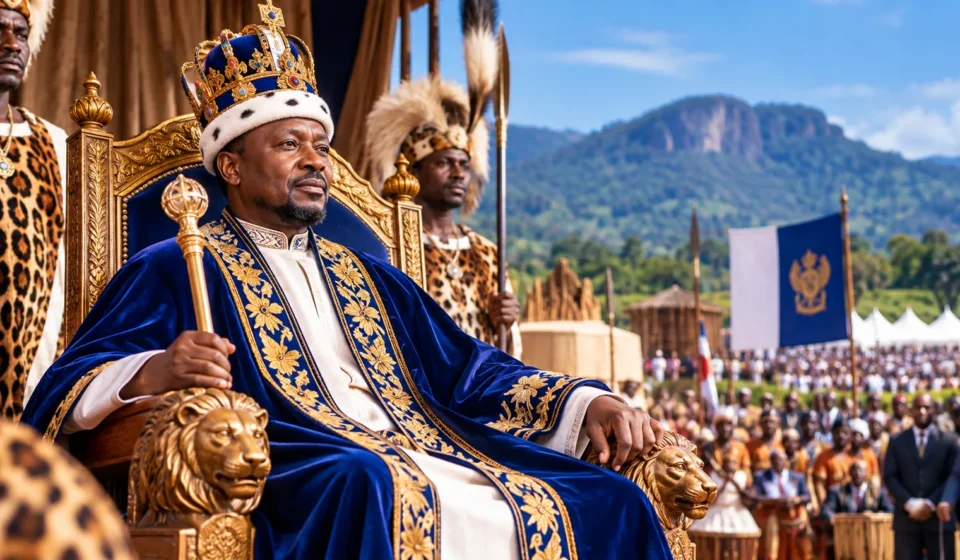

Uganda’s Tooro Kingdom has entered a new chapter after former television journalist Edward Rukidi Kijanangoma was crowned as its new king, following the death of longtime monarch Oyo Nyimba Kabamba Iguru Rukidi IV.
The coronation took place in Fort Portal on September 29, 2026, drawing large crowds and national attention.
Kijanangoma, who previously worked as a news anchor and editor with Uganda Broadcasting Corporation, has taken the royal name Edward Rukidi Nyabongo I.
His rise from broadcast journalism to the throne has made the transition one of the most unusual royal successions in recent Ugandan history.
A Journalist Becomes a King
Before the coronation, Kijanangoma was better known for his work in media than for an active public role inside the monarchy.
He had built a professional career in broadcasting and journalism, making his selection as king particularly striking.
The move highlights the unusual way traditional monarchies in Uganda can intersect with modern professional life.
Unlike constitutional monarchies in Europe, Uganda’s traditional kingdoms are cultural institutions rather than governing authorities.
That means a royal successor may have spent much of his life outside formal royal duties before being called to the throne.
King Oyo’s Death Changed the Succession
The new coronation followed the death of King Oyo in August 2026.
Oyo had ruled the Tooro Kingdom for more than three decades after becoming king as a small child in 1995.
His early accession made him internationally famous.
He was only three years old when he took the throne after the death of his father.
Over time, he became one of Uganda’s most recognizable traditional monarchs.
His death at the age of 34 created immediate uncertainty over who should succeed him.
No Publicly Recognized Heir
The succession became controversial because King Oyo had no publicly acknowledged heir at the time of his death.
That opened the door for senior members of the Babiito royal clan to begin a traditional selection process.
They eventually chose Kijanangoma as the next monarch.
However, the decision was challenged by members of Oyo’s immediate family.
The dispute quickly became one of the most discussed aspects of the royal transition.
The Queen Mother Disputes the Process
Queen Mother Best Kemigisa has publicly questioned the legitimacy of the succession process.
She has claimed that King Oyo had a biological son who should be considered the rightful heir.
That alleged heir has not been publicly identified.
Kemigisa also criticized the speed at which the royal clan moved to select a successor.
She argued that the process began too soon after Oyo’s death and before the royal family had completed its mourning period.
Those claims have kept the succession debate alive even after the coronation.
The Royal Clan Defends Its Decision
Members of the Babiito clan have taken a different position.
They say no formally recognized heir had been presented to them and that they therefore followed customary procedures to choose a new king.
From their perspective, the succession needed to be resolved quickly in order to preserve continuity within the kingdom.
The coronation of Edward Rukidi Nyabongo I was therefore presented as the completion of a traditional process rather than a political appointment.
A Major Ceremony in Fort Portal
The coronation ceremony in Fort Portal became a major cultural event.
Thousands attended, including community leaders, royal officials and senior government representatives.
President Yoweri Museveni was among those present.
The new king used the occasion to emphasize unity, culture and responsibility.
His first public messages focused on preserving Tooro traditions and strengthening social cohesion within the kingdom.
Uganda Remains a Republic
The coronation does not change Uganda’s political system.
Uganda remains a republic with an elected government and president.
Traditional monarchs do not hold executive or legislative authority.
Their role is primarily cultural.
Uganda restored traditional kingdoms in the 1990s after they had previously been abolished.
Since then, monarchs have served as custodians of heritage, language and custom.
They are also expected to remain outside party politics.
Why Traditional Monarchies Still Matter
Even without formal political power, Uganda’s traditional kings remain influential.
They are important symbols of regional identity.
They often participate in education, health, development and cultural initiatives.
For many communities, the monarchy represents historical continuity.
That helps explain why disputes over succession can generate strong public emotion.
The position of king may be ceremonial in law, but it still carries deep social significance.
The Tooro Kingdom’s Place in Uganda
The Tooro Kingdom is based in western Uganda, with Fort Portal serving as its main cultural center.
It is one of several traditional kingdoms recognized by the state.
The Babiito dynasty has long played a central role in the kingdom’s identity.
The monarchy is closely connected to the history and traditions of the Batooro people.
That makes the choice of a new king much more than a symbolic family matter.
It affects an institution that many people see as part of their collective identity.
King Oyo’s Long Reign
King Oyo’s reign shaped an entire generation.
Because he became king as a child, his life was closely followed both inside Uganda and internationally.
During his rule, he took part in cultural initiatives and public campaigns.
He also became involved in international humanitarian and health-related activities.
His long tenure helped modernize the public image of the Tooro monarchy.
That legacy now creates a difficult comparison for his successor.
A New King With a Different Background
Edward Rukidi Nyabongo I enters the role with a very different public profile.
His background in journalism gives him experience in communication, public presentation and media.
Those skills could become important as the kingdom tries to maintain relevance among younger generations.
His career also reflects how traditional institutions are adapting to modern Uganda.
The new king is not emerging from isolation.
He comes to the throne with experience in contemporary professional life.
Legitimacy May Be His First Major Challenge
The biggest immediate issue for the new monarch is legitimacy.
A coronation can formally install a king, but it does not automatically eliminate disagreement.
If parts of the royal family continue to challenge the succession, the dispute could remain active for months.
There is also the possibility of legal action if competing claims are formally pursued.
That could bring traditional succession rules into direct contact with Uganda’s modern court system.
Could the Dispute Reach the Courts?
A legal challenge would create a complicated situation.
Courts would have to consider the relationship between customary royal practice and formal national law.
Uganda recognizes traditional institutions, but they operate within a modern constitutional framework.
That means disputes over royal succession can become both cultural and legal questions.
If the Queen Mother or another claimant decides to pursue the matter formally, the coronation may not be the final chapter.
More Than a Royal Story
The Tooro succession is also a story about modern Uganda.
It shows how old institutions continue to evolve inside a rapidly changing society.
A former television journalist becoming king captures that contrast perfectly.
It brings together tradition, media, law, politics and identity in one event.
That is why the coronation has attracted attention well beyond western Uganda.
What Comes Next
Edward Rukidi Nyabongo I now faces the task of establishing his authority as a cultural leader.
He will need to build support among clan leaders, the royal family and the wider Tooro community.
He will also have to define what the monarchy should represent in the years ahead.
For some, the priority will be preserving tradition.
For others, it will be development, education and modernization.
Balancing those expectations may define the early years of his reign.
A New Chapter for Tooro
The coronation of a former television journalist as king marks a striking transition for the Tooro Kingdom.
It is a story rooted in tradition, but shaped by modern institutions and public debate.
The new monarch now inherits not only a throne, but also a succession dispute and the legacy of one of Uganda’s most recognizable traditional rulers.
Whether his reign begins a period of stability or a longer contest over legitimacy will depend on what happens next.
For now, one thing is clear: the Tooro Kingdom has a new king, and his arrival has placed Uganda’s traditional monarchy back in the national spotlight.