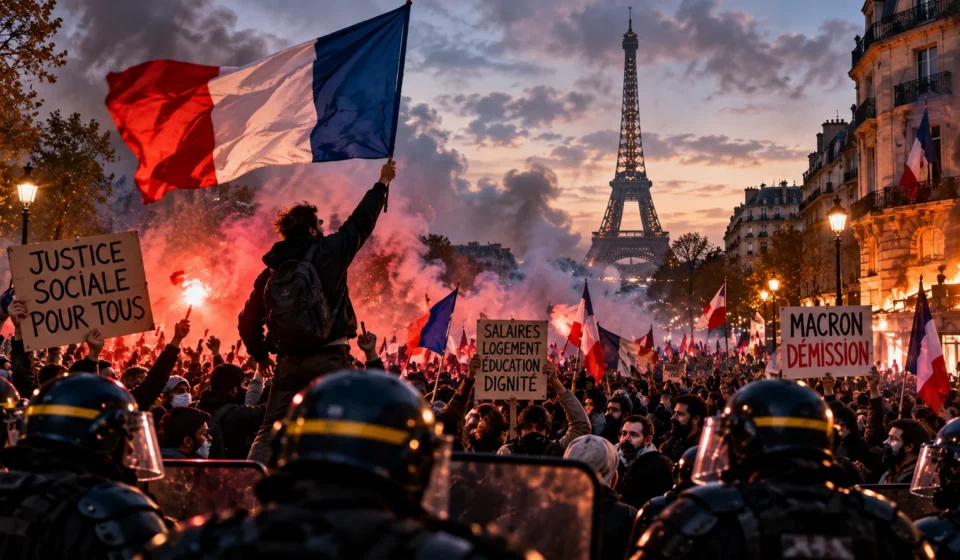

France has once again demonstrated that when public frustration reaches critical mass, the preferred national response is not usually a strongly worded email.
On October 17, 2026, huge demonstrations swept across the country, bringing together high school students, university students, trade unions, Yellow Vest activists and citizens angry about the rising cost of living and deteriorating public services.
French authorities estimated that around 550,000 people joined the protests nationwide, including approximately 110,000 in Paris. Organizers put the national figure closer to 800,000.
Most demonstrations were peaceful.
Some were very much not.
Clashes, fires, looting and attacks on public buildings were reported in several major cities, turning what began as a broad social protest into one of France’s most serious episodes of unrest in recent years.
The Protests Did Not Begin With One Issue
Unlike some previous French protest movements, the latest unrest does not revolve around a single reform.
Instead, it has become a kind of national collection box for frustration.
The main grievances include:
- rising living costs;
- wages and pensions;
- declining public services;
- conditions in schools;
- education funding;
- police tactics;
- broader dissatisfaction with government policy.
The October 17 demonstrations attempted to bring these different causes together under what activists described as a “convergence of struggles.”
Or, translated into simpler language: almost everyone brought their own reason to be angry.
Students Helped Light the Fuse
The current wave of unrest grew out of a student protest movement that began in September.
What started with complaints about staffing shortages and poor conditions at schools in the Paris suburbs spread rapidly across the country.
By October 1, more than 1,000 French schools — roughly one in four nationwide — had joined the movement.
Students complained about overcrowding, missing teachers, academic pressure and deteriorating facilities.
The movement then expanded.
University students joined.
Teachers showed support.
Parents and union activists appeared.
And eventually the protests became much larger than an education dispute.
France’s Gen Z Has Entered the Chat
The demonstrations have also looked different from traditional French labor protests.
Social media has played a major role in organizing the movement.
WhatsApp, Instagram and Signal groups have allowed students to coordinate quickly across schools and cities.
The protests have also developed their own Gen Z culture.
At earlier demonstrations, young protesters held dance battles, wore unusual costumes and mixed political slogans with social-media humor.
At one Paris rally, protesters filled Place de la Bastille while groups staged improvised “aura battles” in front of riot police.
For a few hours, it looked less like a traditional revolution and more like TikTok had accidentally discovered 1789.
Then the tear gas arrived.
Police Tactics Became Part of the Protest
The government’s response to the student demonstrations quickly became a major issue itself.
Thousands of arrests were made during the first weeks of unrest.
Le Monde reported 6,059 arrests between September 28 and October 5, while images of injured teenagers triggered a national debate over police tactics.
Several serious injuries have been investigated.
In one case, a young protester in Saint-Étienne lost a hand, reportedly after an incident involving a police grenade.
Other students suffered severe injuries involving riot-control weapons.
Police unions, meanwhile, argue that officers have been placed under enormous pressure and increasingly face violent groups using demonstrations as cover for attacks.
That has created a second debate running parallel to the protests themselves:
Who is escalating whom?
October 17 Changed the Scale of the Crisis
The October 17 mobilization marked a major turning point.
Demonstrations took place in roughly 110 locations across France, according to reporting from the day.
Large crowds marched in Paris, Lyon, Marseille, Bordeaux, Lille and other cities.
But the day also produced widespread violence.
Authorities reported attacks on shops, police stations and government buildings.
Looting occurred in parts of Paris.
In Marseille, protesters briefly entered the city hall.
In Limoges, the historic city hall was set on fire.
The peaceful majority of protesters increasingly found themselves competing for attention with images of burning buildings.
Which, from a communications perspective, is rarely ideal.
The Government Says Rioters Hijacked the Movement
President Emmanuel Macron condemned the violence and accused groups involved in attacks and looting of attempting to undermine French institutions.
Interior Minister Laurent Nuñez similarly defended the right to demonstrate while arguing that violent groups had exploited the protests.
The government has pointed particularly to radical far-left activists and opportunistic looters.
Opposition politicians have pushed back, accusing the authorities of using disorder to distract from legitimate grievances and criticizing the scale of police repression.
The debate has therefore become as political as it is social.
France’s Old Yellow Vests Are Back Too
Another familiar symbol has returned to the streets.
Calls to revive the Yellow Vest movement, which shook France beginning in 2018, circulated heavily on social media before the October 17 protests.
The original movement began over fuel taxes before evolving into a much broader revolt against inequality and government policy.
Many of the themes now sound familiar:
living costs,
public services,
economic inequality,
and the belief that political elites are increasingly disconnected from ordinary households.
Eight years later, France appears to have discovered that unresolved political anger has surprisingly good shelf life.
Cost of Living Is the Broader Economic Problem
The protests also highlight a wider economic challenge.
Many households believe their purchasing power is declining while essential costs remain high.
That frustration is particularly acute among lower-income families and public-sector workers.
For markets and businesses, sustained social unrest can have real consequences.
Strikes and road blockades can disrupt transport and logistics.
Retail activity may decline in affected areas.
Tourism can suffer.
Government spending pressures may increase if authorities respond with higher wages, subsidies or new public-service commitments.
Businesses Are Watching Paris Carefully
France is one of Europe’s largest economies.
That means prolonged unrest can have implications beyond domestic politics.
International investors watch French government finances, consumer confidence and political stability closely.
If protests lead to large new spending commitments, questions could emerge over France’s already strained public finances.
If the government instead maintains fiscal restraint, social tensions may continue.
It is not an especially comfortable policy menu.
Macron’s Final Months Are Becoming Increasingly Difficult
The unrest also comes at an awkward political moment.
Macron is approaching the end of his presidency, with France preparing for another presidential election.
The protests are therefore becoming part of a much wider political struggle over what comes next.
Opposition parties are attempting to frame the unrest according to their own narratives.
The left argues that the protests reflect inequality and deteriorating public services.
The right emphasizes disorder, crime and the government’s inability to maintain control.
Students, meanwhile, mostly seem interested in getting enough teachers into their classrooms.
Why the Situation Is So Difficult to Resolve
One reason the protests are hard to calm is that there is no single demand the government can simply accept or reject.
The movement now includes very different groups.
Students want better schools.
Workers want higher pay.
Pensioners worry about purchasing power.
Yellow Vest activists want broader economic change.
Some protesters oppose police tactics.
Others are protesting the entire political system.
There is no single negotiating table big enough for all of them.
Violence Could Weaken Public Support
The scale of unrest gives protesters political leverage.
But violence also creates a risk.
When demonstrations turn into looting and arson, public debate often shifts away from economic grievances and toward law and order.
That can divide the protest movement.
Peaceful participants may distance themselves from radicals.
The government may gain greater public support for tougher policing.
This dynamic has appeared repeatedly during previous French protest cycles.
The Economic Impact Could Grow if Protests Continue
One large protest rarely changes an economy.
Weeks of disruption can.
If demonstrations continue, several sectors could begin feeling greater pressure.
Transportation and logistics may face delays.
Retail businesses in major cities could lose sales.
Tourism could weaken.
Insurance claims may increase.
And labor strikes could affect public transport or industrial production.
The longer the crisis lasts, the more likely it becomes that financial markets begin treating the protests as an economic rather than purely political story.
The World Is Watching a Familiar French Pattern
France has a long history of mass protest.
That history sometimes leads outsiders to treat demonstrations as almost routine.
But the current movement deserves more attention.
It began with teenagers complaining about schools.
It expanded into a national debate about living standards.
It brought unions and Yellow Vest activists back into the streets.
And it eventually produced hundreds of thousands of demonstrators across the country.
That is not simply another Saturday in Paris.
Even by French standards, it is significant.
What Happens Next
The immediate question is whether the government can separate peaceful protesters from violent groups while offering enough concessions to reduce public anger.
If authorities respond only with tougher policing, protests could intensify.
If they offer substantial economic concessions, France’s fiscal position could come under greater pressure.
And if nothing changes, the movement may simply continue.
For Macron’s government, none of the available options looks particularly painless.
France Has Entered Another Period of Political Uncertainty
The latest protests reveal something deeper than dissatisfaction with one policy.
They expose growing frustration with public services, purchasing power and political institutions.
France has experienced major protest movements before.
But the combination of student activism, economic anger, union involvement and renewed Yellow Vest energy makes the current situation especially unpredictable.
Hundreds of thousands of people have already taken to the streets.
The government is under pressure.
Police tactics are being questioned.
And presidential politics are beginning to shape the debate.
France may eventually find a political compromise.
It usually does.
But first, apparently, everyone needs to spend some time marching through Paris.