Iran Conflict Triggers Oil Price Shock and Sends Global Markets Into a New Wave of Volatility

Global markets were shaken in March 2026 as escalating conflict around Iran pushed oil prices sharply higher and revived fears of another inflation shock.
The immediate concern was energy.
But the consequences quickly spread far beyond crude oil.
Stocks fell, bond yields moved higher, currencies swung sharply and investors began reconsidering the outlook for global growth.
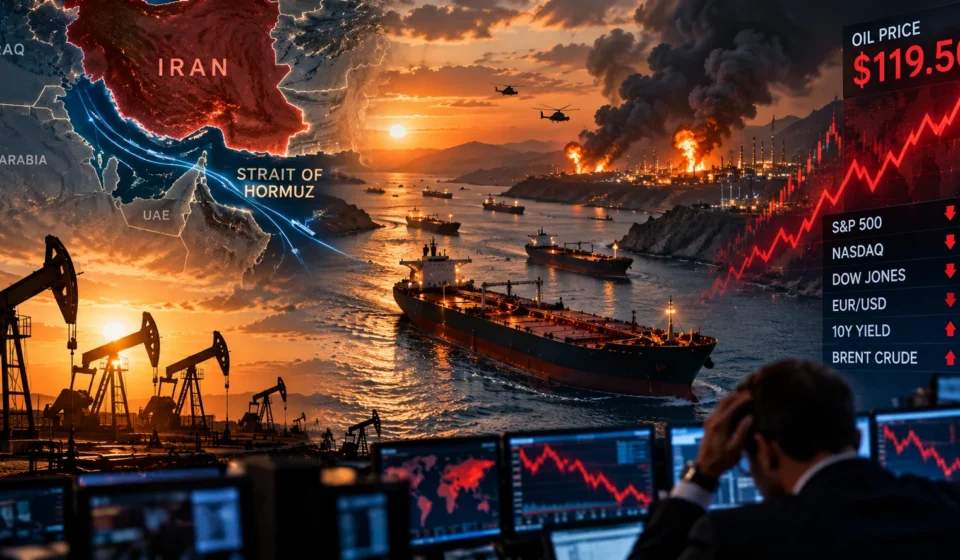
At the center of the crisis was one of the world’s most important shipping routes: the Strait of Hormuz.
The narrow passage carries a large share of global oil exports, and any disruption there has the potential to affect economies thousands of miles away.
Why the Oil Market Reacted So Aggressively
Oil prices are highly sensitive to supply risk.
When conflict threatens major producing countries or transport routes, traders begin pricing in the possibility that fewer barrels will reach the global market.
That is exactly what happened in March.
Brent crude moved rapidly above the psychologically important $100 level and briefly approached $120 per barrel during the most volatile part of the crisis.
The size of the move showed how quickly geopolitical risk can become a financial-market event.
Investors were no longer asking whether the conflict would affect energy markets.
They were asking how severe the disruption might become.
Hormuz Became the Center of Attention
The Strait of Hormuz links the Persian Gulf with the Arabian Sea.
It is one of the most important energy corridors on the planet.
A substantial share of global oil exports normally passes through the strait every day.
That makes the route strategically critical.
When tanker activity fell sharply during the conflict, markets immediately began pricing in a possible supply shortage.
The problem was not simply whether oil-producing countries still had crude available.
The problem was whether that crude could physically reach international buyers.
Shipping Disruption Turned Political Risk Into a Supply Problem
Geopolitical tensions often move oil prices even when actual production remains stable.
This time, however, transport disruption created a more direct problem.
Reduced tanker traffic meant storage facilities in parts of the Gulf began filling.
Some producers were forced to reduce output because they could not export crude at normal rates.
That distinction matters.
Markets react far more strongly when a theoretical risk becomes a physical constraint on supply.
Oil Above $100 Changed the Inflation Debate
Once crude moved above $100, the conversation in financial markets changed quickly.
Before the crisis, investors had been focused on whether inflation would continue to ease and whether central banks could eventually reduce interest rates.
A sudden rise in energy prices challenged that assumption.
Oil affects inflation directly through fuel and transportation costs.
It also affects prices indirectly by increasing production and logistics expenses across the economy.
This raised the possibility that inflation could remain higher for longer.
The Return of Stagflation Fears
One of the most uncomfortable words in economics returned to market commentary: stagflation.
Stagflation refers to a situation where inflation remains elevated while economic growth weakens.
An energy shock can create exactly that combination.
Consumers spend more on fuel and utilities.
Businesses face higher operating costs.
Profit margins come under pressure.
At the same time, central banks may be reluctant to cut interest rates because inflation is still too high.
For investors, this creates a particularly difficult environment.
Equity Markets Became More Volatile
Global stock markets reacted quickly to the energy shock.
Higher oil prices can be positive for energy producers, but they are often negative for many other sectors.
Companies with high fuel or transportation costs face immediate pressure.
Consumer businesses can also suffer if households have less disposable income after paying more for energy.
This helps explain why the selloff spread well beyond the oil industry.
Airlines Were Among the Most Exposed
Airlines are especially vulnerable to sudden increases in crude prices.
Jet fuel is one of their largest operating expenses.
When oil rises quickly, carriers may struggle to pass the full increase on to passengers.
That can reduce margins.
Transportation and logistics companies face a similar problem.
Trucks, cargo ships and delivery networks all depend heavily on fuel.
This means energy inflation can spread through the entire supply chain.
Manufacturing Costs Also Move Higher
Oil is not only a transportation commodity.
It is deeply connected to industrial production.
Petrochemicals are used in plastics and manufacturing.
Energy is required to operate factories.
Natural gas is important for fertilizer production.
When energy costs rise sharply, companies across multiple industries may face higher expenses.
Some absorb those costs.
Others pass them on to customers.
Either way, the impact reaches corporate earnings.
Bond Markets Sent Their Own Warning
Government bond markets also responded to the oil shock.
If investors expect higher inflation, they often demand higher yields to hold long-term debt.
That can push borrowing costs higher across the economy.
Mortgage rates, corporate financing and government borrowing can all become more expensive.
The oil shock therefore threatened to tighten financial conditions even without a central-bank rate increase.
Central Banks Faced a Difficult Choice
An energy-driven inflation shock creates a policy dilemma.
Higher interest rates cannot produce more oil.
But central banks may still have to act if rising energy prices begin affecting broader inflation expectations.
This creates a difficult balance.
Cut rates too quickly, and inflation could become more persistent.
Keep rates high, and economic growth may weaken further.
The conflict therefore complicated monetary policy at exactly the wrong moment.
Currency Markets Also Reacted
The U.S. dollar initially benefited from safe-haven demand.
Investors often move toward the dollar during periods of geopolitical uncertainty.
But the broader currency impact differed by country.
Energy importers faced additional pressure because higher oil prices increase import bills.
That can weaken trade balances and put pressure on local currencies.
Emerging markets were particularly sensitive.
Energy Importers Were More Vulnerable
Countries that rely heavily on imported oil face several simultaneous problems during an energy shock.
Fuel becomes more expensive.
Trade deficits can widen.
Inflation can rise.
Governments may spend more on subsidies.
Central banks may need to keep rates higher.
This can create a difficult combination of slower growth and financial pressure.
Exporters Saw a Different Picture
Oil-producing countries outside the conflict zone faced a different situation.
If they could continue exporting normally, higher crude prices could increase revenues.
Energy companies also benefited from stronger pricing.
This created sharp differences between sectors and economies.
Some markets were hit by higher costs.
Others benefited from higher commodity income.
Food Prices Could Eventually Be Affected
Energy shocks also reach agriculture.
Farm machinery uses fuel.
Fertilizer production depends heavily on natural gas.
Food has to be transported from farms to processors, warehouses and retailers.
If high energy prices persist, those costs can eventually appear in food prices.
That is one reason prolonged oil shocks can become a broader inflation problem.
Governments Considered Emergency Measures
As prices surged, governments and international energy organizations began discussing intervention.
Strategic petroleum reserves became part of the conversation.
Emergency stockpiles can temporarily increase supply and calm markets.
But they are not a permanent solution.
Reserves cannot replace disrupted production or blocked shipping routes indefinitely.
Their main role is to buy time.
Energy Infrastructure Became a Strategic Target
The crisis became more serious as energy infrastructure itself came under pressure.
Refineries, terminals and storage facilities are especially important because damage can create longer-term disruption.
A temporary shipping problem may be resolved quickly.
Damaged infrastructure can take weeks or months to repair.
This increased uncertainty around the duration of the shock.
Oil Prices Reversed Just as Quickly
One of the most striking features of the episode was the speed of the reversal.
Brent crude approached $120 before falling sharply when political signals suggested the conflict might de-escalate.
Stocks also recovered rapidly.
This showed how much of the market move was driven by expectations.
When traders believed the disruption could last, prices surged.
When the probability of a longer conflict appeared to fall, markets reversed.
Geopolitical Headlines Became Market Data
During the most volatile days, investors were reacting to diplomatic statements almost as quickly as they reacted to economic data.
A single comment from a political leader could move oil by several dollars.
That level of sensitivity reflected extreme uncertainty.
Traditional indicators such as inventories and demand still mattered.
But short-term trading was increasingly dominated by news flow.
The Crisis Exposed Global Dependence on Chokepoints
The episode also highlighted a broader weakness in the global economy.
Trade depends on a small number of critical routes.
Hormuz is one of them.
Others include the Suez Canal, the Panama Canal and key shipping lanes in Asia.
When one chokepoint becomes unstable, the impact can spread rapidly through commodities, shipping and financial markets.
Energy Security Returned to the Center of Policy
The crisis reminded governments that energy security remains strategically important even as renewable power expands.
Oil and gas are still critical for transport, industry and global trade.
A disruption in the Gulf can therefore have consequences across Europe, Asia and North America.
The transition to cleaner energy has not eliminated this vulnerability.
Why Investors Paid So Much Attention
The March 2026 oil shock mattered because it hit several market narratives at once.
It challenged expectations for lower inflation.
It complicated central-bank policy.
It raised the risk of slower growth.
It created volatility in currencies and bonds.
And it increased uncertainty around corporate earnings.
That is why the event became much larger than a simple move in crude prices.
The Real Risk Was the Combination of Shocks
Oil alone was not the only problem.
The real concern was the possibility that several pressures could overlap.
Higher oil prices.
Shipping disruption.
Rising inflation.
Expensive borrowing.
Weaker consumer demand.
Slower global growth.
When these factors occur together, the impact on markets can become much more severe.
What the March Shock Taught Global Markets
The biggest lesson was simple.
Energy can still dominate the global financial system.
Despite advances in technology and changes in the structure of the world economy, oil remains deeply connected to inflation, transportation, manufacturing and trade.
A disruption in one narrow waterway was enough to change expectations across global markets within days.
A Regional Conflict With Global Consequences
The Iran conflict was geographically concentrated.
Its financial impact was not.
Oil markets reacted first.
Then stocks, bonds and currencies followed.
Businesses began reassessing costs.
Governments discussed emergency measures.
Central banks faced a more difficult inflation outlook.
The episode showed how quickly geopolitical risk can become economic risk.
For several days in March 2026, the direction of global markets depended less on earnings reports or economic data and more on whether energy could continue moving safely through the Strait of Hormuz.
That is what made the crisis one of the most important market events of the period.