
Samsung is preparing to turn millions of Galaxy smartphones into something slightly more ambitious than communication devices.
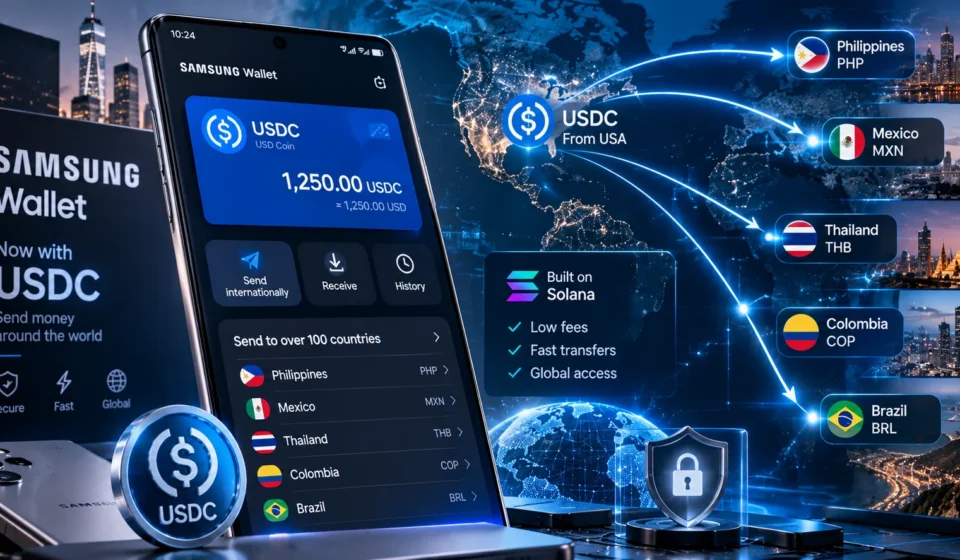
Starting in the last week of October 2026, eligible Galaxy users in the United States will be able to access USDC directly through Samsung Wallet, allowing them to send stablecoins internationally without installing a separate crypto app or managing private keys themselves.
In other words, the phone you already use for messages, boarding passes, car keys and contactless payments is about to gain another job.
It is now also becoming a stablecoin transfer tool.
Because apparently smartphones were feeling underemployed.
First, an Important Correction: It Is USDC, Not USDT
There has already been some confusion around the announcement.
Samsung is initially supporting USDC, not USDT.
USDC is the dollar-denominated stablecoin issued by Circle and widely used for payments, transfers and settlement across multiple blockchain networks.
Samsung says USDC will be the first stablecoin integrated into the new service.
That distinction matters because different stablecoins operate under different issuers, regulatory frameworks and infrastructure.
So if someone tells you Samsung just put USDT into every Galaxy phone, you may want to gently remove one letter from that sentence.
What Samsung Actually Announced
Samsung Electronics America announced on October 7 that stablecoin functionality will be added to Samsung Wallet for eligible U.S. Galaxy users.
The rollout is scheduled for the final week of October 2026.
At launch, the feature will allow users to:
- access USDC inside Samsung Wallet;
- send USDC to compatible external wallets;
- send money to eligible bank accounts in more than 60 countries;
- allow recipients to receive local currency directly in their bank accounts;
- authenticate transfers through the Galaxy device itself.
That last point is particularly important.
The recipient does not necessarily need a crypto wallet.
Samsung Wallet can support a transfer where the sender uses USDC while the recipient receives ordinary local currency in a bank account.
That makes the system look less like a traditional crypto product and more like a remittance service using stablecoin infrastructure behind the scenes.
82 Million Devices Could Be Eligible
Samsung says the feature could be available across approximately 82 million Galaxy devices in the United States that are compatible with Samsung Wallet. Solana separately confirmed the same scale for the rollout.
That is not a small experiment.
It represents one of the largest attempts by a mainstream consumer-electronics company to place stablecoin functionality directly inside a mobile wallet used by ordinary consumers.
No separate wallet app.
No copying seed phrases onto paper.
No explaining to your uncle why he should never take a screenshot of 24 words.
Samsung is attempting to hide most of that complexity behind a familiar interface.
The Blockchain Is Supposed to Stay in the Background
One of the most interesting parts of the announcement is what Samsung does not want users to think about.
Blockchain networks.
Private keys.
Custody architecture.
Wallet setup.
The company says users should be able to access the feature without manually managing private keys.
The infrastructure is handled by partners.
Bastion will provide stablecoin-account and cross-border-payment infrastructure, while Coinbase will act as sub-custodian through Coinbase Prime.
Samsung also named Solana and Sui among the infrastructure partners supporting blockchain functionality.
The user, meanwhile, sees Samsung Wallet.
That may be the most important part of the entire strategy.
For mass adoption, successful financial technology often becomes invisible.
People do not want to understand settlement architecture when sending money to a relative.
They want to press “Send.”
Solana Gets a Major Consumer Distribution Win
The Solana Foundation says Samsung Wallet will support cross-border USDC transfers on Solana across approximately 82 million U.S. Galaxy devices.
This gives Solana access to an unusually large mainstream distribution channel.
For blockchain networks, consumer adoption has traditionally required users to download applications, create wallets and learn unfamiliar interfaces.
Samsung is effectively reversing the process.
Instead of asking users to come to blockchain applications, blockchain functionality is coming to a wallet already installed on their phone.
That is a much easier sales pitch.
Sending Money Abroad Is the First Big Use Case
Samsung is initially focusing heavily on international transfers.
Eligible users will be able to send USDC to compatible wallets and send money to eligible bank accounts in more than 60 countries, where recipients may receive local currency directly.
This puts Samsung in territory traditionally dominated by banks, remittance companies and fintech platforms.
And Samsung enters with one major advantage:
the customer may already be holding the product required to use the service.
The Phone Becomes the Authentication Device
Samsung says compatible Galaxy devices will act as the secure gateway for the service.
Biometric authentication on a registered device will be required to initiate transfers.
That means the smartphone itself becomes part of the security architecture.
Samsung is effectively combining the device, biometrics, Samsung Wallet, regulated custody partners and stablecoin settlement into a single user experience.
This is very different from traditional self-custody wallets.
Samsung Is Not Becoming a Bank
There is an important legal detail underneath the shiny interface.
Samsung itself is not acting as the bank, money transmitter or digital-asset custodian.
The stablecoin accounts, custody and money movement are provided by financial and infrastructure partners.
Samsung gets to focus on the device and user experience.
Its partners get the paperwork.
A division of labor many technology companies probably find extremely attractive.
What Users Will Not Be Able to Do Yet
Despite some enthusiastic headlines, Samsung has not announced that Galaxy users can immediately walk into any store and pay for coffee directly with USDC.
At launch, the main functionality is transfers.
Samsung says future versions may allow eligible users to pay online or tap a Galaxy device in a store using stablecoins.
So for now:
Send USDC? Yes.
Send money internationally? Yes.
Recipient receives local currency? Potentially yes.
Tap your Galaxy at a coffee shop and pay directly in USDC? Not yet.
The coffee industry remains safe.
Why This Could Matter More Than Another Crypto App
There are already plenty of crypto wallets.
That is not the interesting part.
The interesting part is distribution.
Samsung Wallet already stores cards, IDs, boarding passes and digital keys for millions of people.
Adding stablecoins to that environment makes them look less like a specialist crypto instrument and more like another normal payment tool.
That psychological shift may matter more than the technology.
Stablecoins Are Moving Into Mainstream Finance
Stablecoins were originally heavily associated with crypto trading.
That use case still exists.
But their role is expanding into:
- remittances;
- international payments;
- business settlement;
- payroll;
- cross-border commerce;
- and financial infrastructure.
Samsung’s rollout is another sign that stablecoins are moving beyond the crypto-native audience.
The target user increasingly may not even think of themselves as a crypto user.
Apple Will Inevitably Enter the Conversation
Samsung’s move naturally raises another question:
What does Apple do?
Apple Wallet already plays a central role in mobile payments for hundreds of millions of iPhone users.
If stablecoin transfers become popular inside Samsung Wallet, competitors may eventually face pressure to offer similar functionality.
That does not mean Apple will announce USDC support tomorrow.
But consumer-finance features have a habit of becoming standard once people start expecting them.
Remittance Companies Should Pay Attention
The international money-transfer market is enormous.
Traditional remittance companies often make money from fees, FX spreads or both.
Stablecoin infrastructure can reduce some of the technical friction involved in moving money across borders.
Samsung’s model is especially interesting because the customer may never need to see the blockchain.
The sender uses Samsung Wallet.
The recipient gets local currency.
USDC operates somewhere in the middle.
For traditional remittance providers, that is worth watching very carefully.
Banks Should Probably Pay Attention Too
Banks are not about to disappear because Samsung added USDC.
But stablecoin-based transfers introduce another competitive layer.
Customers increasingly care about speed, fees, transparency and convenience.
If mobile-wallet transfers become easier or cheaper than conventional international transfers, users will notice.
Banks may respond by improving their own services.
Everyone innovates.
Consumers benefit.
PowerPoint presentations multiply.
The Bigger Story Is Not Crypto
Calling this simply a “crypto feature” may actually understate what Samsung is doing.
The bigger story is financial infrastructure moving into consumer devices.
Your phone already authenticates payments.
It stores identity credentials.
It opens cars.
Now it can also become the interface for stablecoin-based international transfers.
The blockchain increasingly becomes just another backend rail.
That may be what real adoption looks like.
Not a giant button saying “CRYPTO.”
Just a normal transfer screen.
Samsung Is Testing What Mainstream Stablecoin Adoption Might Look Like
For years, the crypto industry has talked about mass adoption.
Usually while requiring people to download several apps, copy long wallet addresses and learn entirely new vocabulary.
Samsung is trying another approach.
Make it boring.
Put it in Samsung Wallet.
Use biometrics.
Hide the blockchain.
Let the recipient receive local currency.
That sounds considerably less revolutionary.
It may also be considerably more effective.
What Happens Next
The initial rollout is scheduled for the last week of October 2026 for eligible Galaxy users in the United States.
Expansion into additional markets will depend on regulatory developments, while future capabilities may include online stablecoin payments and in-store tap-to-pay functionality.
If that happens, the distinction between traditional mobile payments and stablecoin payments could become increasingly difficult for ordinary consumers to notice.
And that may be exactly the point.
The Smartphone Is Becoming the Wallet — Literally
Samsung’s USDC rollout is not simply another feature hidden inside a phone menu.
It is another step toward turning smartphones into financial platforms.
Users can already store cards, IDs, tickets and keys.
Now stablecoins are joining the collection.
The irony is that one of the most important moments in mainstream blockchain adoption may happen precisely when consumers no longer need to understand that they are using blockchain at all.
No seed phrase.
No wallet extension.
No Telegram group explaining gas fees at 2 a.m.
Just Samsung Wallet.
And perhaps that is how financial technology finally becomes truly mainstream.