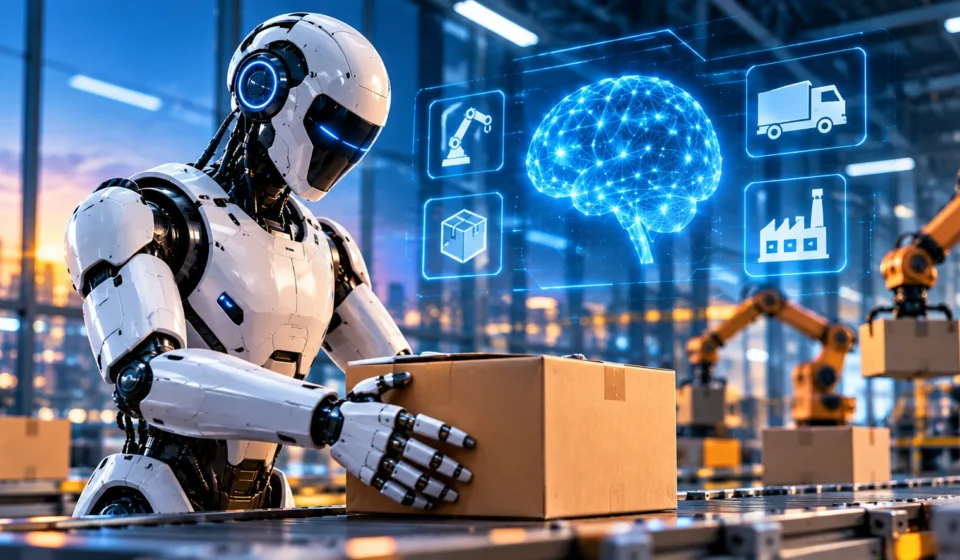
AI Is Entering the Physical World: Why Robotics Could Be the Next Big Artificial Intelligence Revolution

Artificial intelligence is beginning to move far beyond chatbots, search tools and software.
The next stage of AI may be much more tangible: machines that can see, understand, move and perform tasks in the real world.
This shift is giving rise to a new generation of intelligent robots. Unlike traditional industrial machines that repeat the same programmed movements, AI-powered robots are being designed to recognize unfamiliar situations, interpret instructions and adapt their behavior.
That makes robotics one of the most important emerging areas in artificial intelligence.
From Digital AI to Physical AI
Most people still associate artificial intelligence with software.
AI writes text, creates images, translates languages, analyzes documents and helps users search for information.
Physical AI takes the same concept and gives it a body.
Instead of only processing data on a screen, a physical AI system interacts with objects, people and environments.
A robot may use cameras to understand what is in front of it, sensors to measure distance and pressure, and AI models to decide what action should happen next.
This turns artificial intelligence from a digital assistant into an active participant in the physical world.
Why Robotics Is Advancing So Quickly
Robotics has existed for decades, but traditional robots have major limitations.
Most industrial machines work best in environments where everything is predictable.
They can weld the same part thousands of times or move the same object along an assembly line. But if the environment changes, they often need to be reconfigured or reprogrammed.
Modern AI is beginning to change that model.
Advances in computer vision, language models, machine learning and high-performance processors are allowing robots to interpret changing conditions instead of simply following fixed instructions.
The difference is fundamental.
A conventional robot follows a script.
An AI-powered robot is being trained to understand the situation.
Robots Are Starting to Learn Tasks More Like Humans
One of the biggest goals in modern robotics is to reduce the amount of programming required for each individual task.
Instead of writing thousands of lines of instructions, developers want robots to learn by watching demonstrations, analyzing examples and practicing in simulation.
This approach could dramatically change how robots are deployed.
A factory worker might demonstrate how to pick up a component, rotate it and place it into a machine.
An advanced robot could eventually study that action and reproduce it without engineers building an entirely new program.
The idea is similar to the way large AI models learn patterns from enormous datasets.
In robotics, however, the data includes movement, force, distance, object position and interaction with the physical environment.
Humanoid Robots Are Attracting Major Investment
Humanoid robots have become one of the most visible parts of the physical AI industry.
There is a practical reason for their human-like shape.
The modern world has already been designed around people.
Doors, stairs, tools, vehicles, warehouses and factory workstations all assume human dimensions and movement.
A robot with arms, hands and legs may therefore be able to work inside existing infrastructure without requiring companies to redesign everything around the machine.
This is why many technology and robotics companies are developing humanoid platforms for industrial work.
Their first roles are likely to involve repetitive, physically demanding or dangerous tasks.
Factories May Become the First Major Test
Industrial environments are a natural starting point for AI robotics.
Factories provide structured spaces, clearly defined tasks and measurable productivity.
That makes them easier to automate than unpredictable environments such as homes or public streets.
Potential robotic tasks include moving parts, loading machines, handling materials, inspecting equipment and transporting goods.
The key difference is flexibility.
A traditional industrial robot may be designed for one production step.
An intelligent robot could eventually perform several tasks depending on demand.
That could make automation more useful for companies that manufacture different products or frequently change production lines.
Simulation Is Becoming Essential
Teaching robots only in the real world is expensive and slow.
Machines can fall, break equipment and require constant supervision.
Simulation offers an alternative.
Developers can create detailed virtual environments where robots practice thousands or even millions of tasks before operating in a real factory or warehouse.
A simulated robot can learn how to walk across different surfaces, avoid obstacles, lift objects and react to unexpected situations.
This dramatically increases the amount of training available.
It also allows developers to create rare or dangerous scenarios that would be difficult to reproduce safely in reality.
The Rise of Vision-Language-Action Models
Another important development is the emergence of AI models that connect three abilities:
seeing,
understanding language,
and taking action.
These systems are often described as vision-language-action models.
Imagine telling a robot:
“Take the red container from the shelf and place it next to the machine.”
The robot must understand the words, identify the correct object, determine its position, plan a route and control its movement.
This requires far more than simple image recognition.
It requires reasoning about space, objects and consequences.
That is why robotics is becoming one of the most complex applications of artificial intelligence.
AI Chips Are Becoming Critical
Intelligent robots require enormous computing power.
A robot may be processing several camera feeds, sensor information and movement calculations simultaneously.
It may also need to run large AI models in real time.
Sending every decision to a remote cloud server is often impractical because delays can make physical movement unsafe.
As a result, more processing is moving directly onto the robot.
This creates growing demand for powerful but energy-efficient AI processors designed for edge computing.
The semiconductor industry could become one of the biggest beneficiaries if millions of intelligent robots eventually require dedicated computing hardware.
Robotics Could Create a New Software Economy
One of the most interesting possibilities is that robots could eventually become platforms in the same way smartphones became platforms.
Today, users install applications to give their phones new capabilities.
In the future, businesses might install new robotic skills.
A warehouse robot could receive software that teaches it to sort a different type of package.
A manufacturing robot could gain the ability to use another tool.
A service robot might learn a new cleaning procedure.
If this model develops, robotics could create an entirely new software ecosystem built around downloadable physical capabilities.
Safety Is Much Harder in the Physical World
AI mistakes become more serious when software controls machines.
A chatbot that gives an incorrect answer may create confusion.
A robot that makes an incorrect movement can damage equipment or injure someone.
This makes safety one of the most important challenges in physical AI.
Robots must recognize humans, obstacles and dangerous situations immediately.
They also need reliable emergency systems that can stop movement when something unexpected happens.
Cybersecurity is another concern.
As robots become connected to networks and cloud services, protecting them from unauthorized access will become increasingly important.
What Happens to Jobs?
The growth of intelligent robotics will also affect employment.
Some repetitive jobs are likely to become more automated.
Warehousing, manufacturing and logistics could be among the first sectors to experience significant change.
But the effect will not necessarily be limited to job replacement.
New roles are likely to appear in robot maintenance, fleet management, software development, AI supervision and industrial safety.
The bigger question is how quickly companies can deploy robots at a cost that makes economic sense.
Today, advanced humanoid robots remain expensive.
Their long-term impact will depend on whether manufacturers can reduce prices while improving reliability.
The Data Advantage Could Decide the Winners
Artificial intelligence improves through data.
Robotics is no different.
But instead of relying only on text or images from the internet, robots need data about physical actions.
They must learn how objects move, how much force is required to lift something and how environments change.
Companies operating large fleets of robots may gain a major advantage because every machine can generate new training information.
More robots create more data.
More data improves AI models.
Better models make the next generation of robots more capable.
This feedback loop could become one of the most important competitive advantages in robotics.
The Market Could Be Much Larger Than Industrial Automation
The first major deployments may happen in factories and warehouses, but the long-term market could be far broader.
AI-powered robots could eventually appear in healthcare, agriculture, construction, retail, hospitality and home services.
Hospitals could use robots to transport supplies.
Farms could deploy autonomous machines for harvesting.
Construction companies could automate repetitive site work.
Consumers may eventually use robots for household assistance.
Each of these applications requires different skills, hardware and levels of safety.
That means the robotics market may develop into multiple specialized industries rather than one single category.
Why Physical AI Matters
The rise of generative AI showed that computers can interact with language in ways that once seemed impossible.
Physical AI could represent an even bigger challenge.
Machines must understand not only information but also reality.
They need to interpret movement, distance, weight, balance and cause and effect.
They must also operate safely around people.
If researchers and companies can solve these problems, artificial intelligence could move from being mainly a digital technology to becoming part of everyday physical infrastructure.
The Next AI Revolution May Have a Body
For the last several years, the most visible progress in AI has happened on screens.
The next wave may look completely different.
It may arrive as machines that work inside factories, move goods through warehouses, assist medical staff and perform tasks that currently require human hands.
Robotics is still far from reaching its full potential.
But the direction is becoming clear.
Artificial intelligence is no longer only learning how to generate information.
It is learning how to interact with the world.
And that could become one of the defining technology shifts of the next decade.