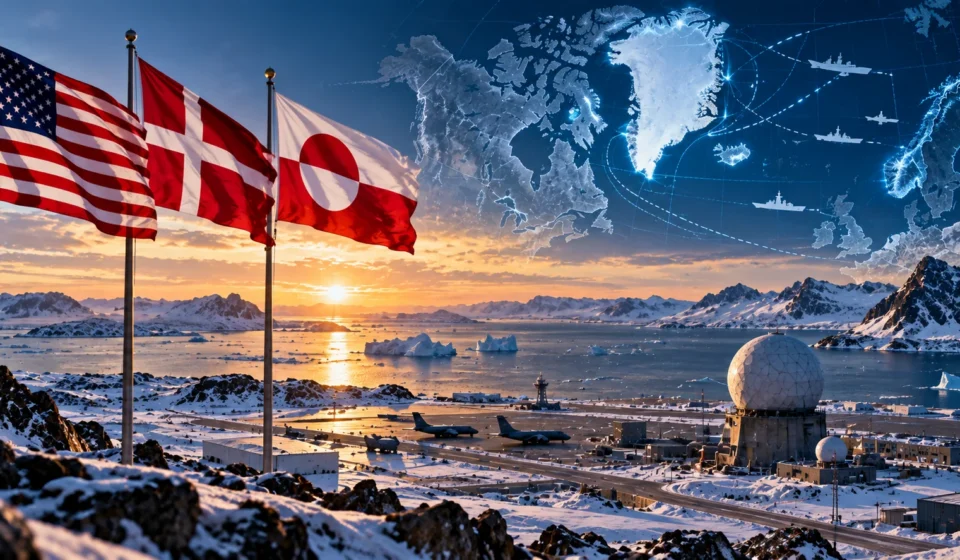
Greenland Moves to the Center of Arctic Security as US, Denmark and Greenland Deepen Defense Cooperation

Greenland is becoming one of the most strategically important locations in the Arctic as the United States, Denmark and Greenland move to deepen their defense cooperation.
A new security framework signed in September 2026 expands the scope of American military activity on the island, strengthens NATO coordination in the High North and reflects a broader shift in how Western governments view the Arctic.
For decades, Greenland was primarily associated with remote geography, scientific research and limited military infrastructure.
That is changing.
Its location between North America and Europe, proximity to Arctic routes and role in missile warning and space surveillance are giving the island growing importance in global security planning.
Why Greenland Matters More Than Ever
Greenland occupies a unique position in the North Atlantic.
It sits along routes that connect North America with Europe and the Arctic, making it valuable for surveillance, early-warning systems and military logistics.
The United States has maintained a defense presence there for decades, most notably through Pituffik Space Base.
But the strategic environment around the Arctic is becoming more competitive.
Russia continues to maintain extensive military capabilities in its northern territories, while China has increased its economic and scientific interest in the region.
At the same time, NATO is placing greater emphasis on northern defense.
This has turned Greenland into a much more important part of wider transatlantic security.
The Agreement Expands US Access
The new arrangement gives the United States broader operational flexibility in Greenland.
American forces will have expanded access to existing facilities and may be able to use additional areas for defense purposes under agreed procedures.
This could support a more distributed military presence across the island.
Such a structure would be valuable for surveillance, communications, missile detection and rapid deployment.
Rather than relying on one central base, the United States could gradually develop a broader Arctic network.
That would make Greenland more deeply integrated into North American and NATO defense planning.
Pituffik Space Base Remains the Core Asset
Pituffik Space Base remains the most important American military facility in Greenland.
The base plays a major role in missile warning, space monitoring and communications.
Its geographic location gives the United States an important vantage point for tracking activity across the Arctic and North Atlantic.
Modernization of Pituffik could therefore become one of the most significant outcomes of the new security framework.
As space-based and missile technologies become more important to modern warfare, facilities like Pituffik are likely to gain even greater strategic value.
NATO Is Paying More Attention to the High North
The agreement also reflects a wider NATO shift toward the Arctic.
For many years, the alliance focused primarily on Central and Eastern Europe.
Today, northern territories are becoming more important.
The Arctic is increasingly connected to maritime security, missile defense, energy infrastructure and undersea communications.
NATO members are therefore investing more heavily in northern surveillance and military readiness.
Greenland fits naturally into that strategy.
Its location gives the alliance access to a critical area between the Atlantic and Arctic regions.
Denmark Strengthens Its Arctic Role
For Denmark, the agreement reinforces responsibility for defense in the Kingdom of Denmark.
Copenhagen has already been increasing investment in Arctic surveillance, ships, aircraft and communications.
The new security framework allows Denmark to coordinate these efforts more closely with the United States.
This is important because Arctic defense is expensive.
The region is vast, infrastructure is limited and weather conditions are difficult.
Cooperation allows allied countries to share costs, technology and intelligence.
Greenland Gains Strategic Weight
For Greenland itself, the agreement creates both opportunities and challenges.
Greater military importance could lead to more investment in infrastructure, transport and local services.
Construction projects, logistics and maintenance contracts could benefit Greenlandic businesses.
At the same time, a larger foreign military presence may raise concerns about sovereignty, environmental protection and local control.
Greenland’s political leaders have repeatedly emphasized that decisions about the island’s future must involve Greenlanders directly.
That issue is likely to remain central as security cooperation expands.
Self-Determination Remains a Sensitive Issue
Greenland has broad autonomy within the Kingdom of Denmark and retains the right to pursue independence in the future.
This makes any major defense agreement politically sensitive.
The new framework seeks to preserve Greenland’s constitutional rights while strengthening military cooperation.
The challenge is balancing long-term strategic commitments with Greenland’s own political development.
If independence becomes a more serious possibility in the future, questions about NATO membership and defense arrangements could become even more important.
Critical Minerals Add Another Dimension
Greenland’s value is not limited to defense.
The island is also believed to contain important deposits of rare earths and other critical minerals.
These materials are increasingly important for batteries, electronics, renewable energy and military systems.
That makes foreign investment in Greenland more strategically sensitive.
Western governments are concerned about dependence on supply chains controlled by geopolitical competitors.
As a result, Greenland could become increasingly important in efforts to diversify access to critical raw materials.
Arctic Resources Are Becoming a Security Issue
Energy and mineral resources in the Arctic are increasingly linked to national security.
Countries are no longer treating mining, infrastructure and logistics as purely commercial questions.
They are also considering who controls supply chains and whether foreign investment creates strategic dependence.
This means Arctic economic policy and defense policy are becoming more closely connected.
Greenland sits directly at the center of that trend.
Climate Change Is Opening New Arctic Routes
Another major factor is climate change.
As sea ice retreats, parts of the Arctic are becoming more accessible during longer periods of the year.
This could increase commercial shipping and resource exploration.
Northern routes may eventually offer shorter connections between parts of Asia, Europe and North America.
However, greater accessibility also creates security challenges.
More ships, infrastructure and commercial activity mean governments need stronger surveillance and emergency-response capabilities.
This gives Greenland additional importance as a base for Arctic monitoring.
The Arctic Is Becoming More Competitive
The High North was once seen as a relatively stable region where international cooperation remained possible despite tensions elsewhere.
That environment is changing.
Military investment is rising.
Countries are paying more attention to Arctic infrastructure.
Critical minerals are becoming more important.
Shipping routes are attracting strategic interest.
These developments are creating a more competitive environment.
The new US–Denmark–Greenland framework is one example of how governments are adapting.
Russia Remains a Major Factor
Russia has the longest Arctic coastline and operates significant military infrastructure across its northern territories.
That makes Russian activity a central factor in NATO planning.
The alliance is particularly focused on surveillance, air defense and maritime access.
Greenland’s location allows NATO countries to monitor parts of the North Atlantic and Arctic approaches.
This makes the island highly relevant to early-warning systems and broader regional security.
China’s Arctic Interest Is Also Being Watched
China is not an Arctic state, but it has shown growing interest in the region.
Chinese companies have previously explored opportunities related to mining, infrastructure and scientific cooperation.
Western governments increasingly view such investments through a national-security lens.
This does not mean that every Chinese project is automatically treated as a threat.
But strategic sectors are now receiving much closer scrutiny.
The new security framework reflects this broader shift toward tighter control of foreign investment in sensitive infrastructure.
Economic Opportunities Could Expand
Greater security activity could bring economic benefits to Greenland.
Military projects require construction, transport, fuel, communications and local services.
If procurement rules favor local participation, Greenlandic companies could gain new business opportunities.
Improved infrastructure could also support civilian activity.
Airports, roads and communications built for defense can sometimes provide wider economic benefits.
However, these gains will depend on how projects are structured and how much local participation is included.
Environmental Concerns Will Remain Important
Arctic ecosystems are highly sensitive.
Any expansion of military infrastructure must therefore consider environmental risks.
Construction, fuel storage and transportation can all affect fragile landscapes.
Traditional hunting and fishing activities also remain important to many Greenlandic communities.
Balancing security priorities with environmental protection will be one of the most difficult policy challenges.
The Agreement Has Wider Geopolitical Meaning
The new security framework is important because it reflects a larger global trend.
Geography is becoming strategically important again.
Countries are reassessing ports, islands, airfields and transport corridors based on defense value.
Greenland is a clear example.
Its small population contrasts sharply with its enormous strategic importance.
For NATO and the United States, the island offers access to a key northern position.
For Denmark, it strengthens its role in Arctic security.
For Greenland, it creates new leverage and new responsibilities.
What to Watch Next
Implementation will now be the key issue.
Attention is likely to focus on several areas:
- expansion of US military infrastructure;
- modernization of Pituffik Space Base;
- new NATO exercises;
- foreign investment screening;
- critical mineral projects;
- Greenlandic participation in defense-related contracts.
How quickly these developments move forward will determine the real impact of the agreement.
Greenland Is No Longer on the Geopolitical Periphery
The broader message is clear.
Greenland is moving from the edge of global strategy toward the center of Arctic security.
Its location, natural resources and defense infrastructure make it increasingly important to Western planning.
The new US–Denmark–Greenland security framework reinforces that trend.
As competition in the Arctic grows, Greenland is likely to play a much larger role in security, energy and economic policy.
The High North is becoming a strategic frontier.
And Greenland is becoming one of its most important locations.