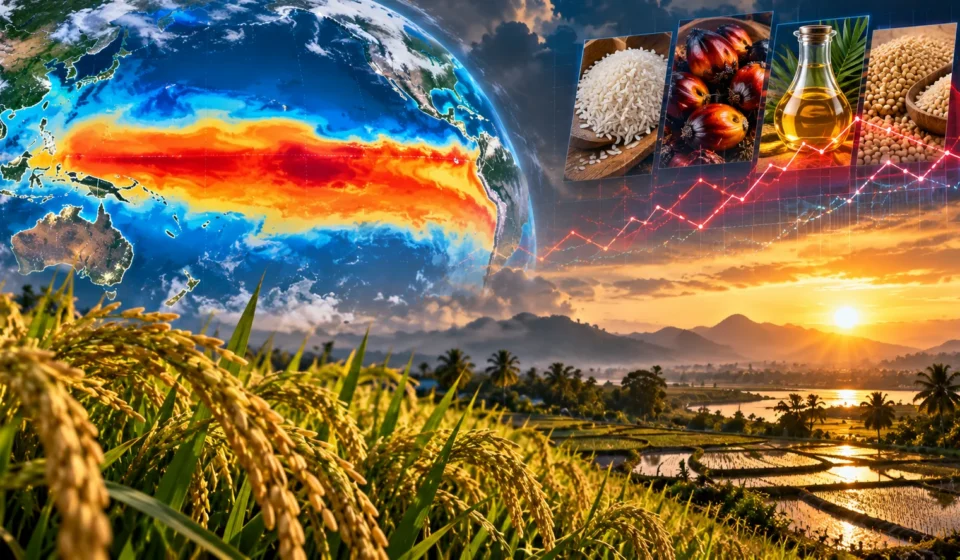

El Niño is returning as a major risk for global agriculture, raising concerns that weaker harvests in Asia could eventually translate into higher food prices around the world.
The weather pattern is especially important for countries that depend heavily on rice, palm oil and other agricultural commodities produced across South and Southeast Asia. If rainfall weakens and temperatures remain elevated, crop yields could come under pressure at the same time that transport, energy and fertilizer costs remain volatile.
For global food markets, the concern is not only about one bad harvest.
The bigger risk is a chain reaction.
Lower agricultural output can tighten exports, increase import demand, push up commodity prices and eventually feed into consumer inflation.
Why El Niño Can Move Global Food Prices
El Niño develops when ocean temperatures in the central and eastern Pacific rise above normal levels.
That warming can change weather patterns far beyond the Pacific itself.
Some regions receive heavier rainfall.
Others experience drought.
For agriculture, the timing of these changes is critical.
A crop can survive moderate weather stress if rain arrives at the right moment. But prolonged heat during planting or flowering periods can sharply reduce yields.
This is why agricultural traders watch El Niño forecasts so closely.
A change in ocean temperatures can eventually affect everything from rice harvests in Asia to vegetable oil prices in Europe.
Asia Is at the Center of the Risk
Asia is especially exposed because it plays a dominant role in both food production and consumption.
The region produces much of the world’s rice and palm oil, while hundreds of millions of households depend on these products every day.
South Asia is vulnerable because El Niño can weaken parts of the monsoon system.
Southeast Asia may also experience drier-than-normal conditions.
If rainfall drops significantly, farmers may face lower reservoir levels, reduced soil moisture and higher irrigation costs.
The impact can spread quickly through supply chains.
A weaker rice harvest in one country may increase demand from another exporter.
Lower palm oil production can push buyers toward soybean oil or sunflower oil.
That means the effects of El Niño often move from one commodity into another.
Rice Could Be One of the First Markets to React
Rice is one of the most important commodities to watch.
Unlike some globally traded crops, rice is closely linked to food security across Asia and Africa.
Many countries rely on imports when local production is insufficient.
This makes the market highly sensitive to weather and export policy.
If major producers experience drought, prices can rise even before the full harvest impact becomes clear.
Traders may begin buying earlier.
Governments may increase strategic reserves.
Importers may compete for available supply.
These reactions can strengthen price movements well before actual shortages appear.
Export Restrictions Could Make the Situation Worse
Weather is only part of the story.
Government policy can amplify agricultural shocks.
When domestic food prices rise, governments sometimes restrict exports to protect local consumers.
That strategy may reduce pressure at home, but it can make the international market much tighter.
This is particularly important for rice.
If a large exporter limits shipments, importing countries may rush to find alternative suppliers.
That can cause prices to rise faster than the underlying production loss alone would justify.
This means the global food market is vulnerable not just to drought, but also to the political response to drought.
Palm Oil Is Another Critical Commodity
Palm oil is heavily concentrated in Southeast Asia, especially in Indonesia and Malaysia.
That concentration makes the market sensitive to regional weather.
Extended dry periods can reduce yields and affect future production.
Palm oil also has an unusually broad role in the global economy.
It is used in packaged food, cosmetics, household products and biofuels.
If palm oil becomes more expensive, food manufacturers may turn to alternative vegetable oils.
That can increase demand for soybean, sunflower or rapeseed oil.
As a result, weather problems in Southeast Asia can influence the entire edible oil market.
Food Inflation Could Return as a Major Concern
Higher agricultural prices do not immediately translate into supermarket inflation.
But the effect can build gradually.
Food manufacturers face higher input costs.
Importers pay more for commodities.
Transportation expenses increase.
Retailers eventually pass some of those costs on to consumers.
The impact is usually strongest in countries where food represents a large share of household spending.
For lower-income economies, even a modest rise in staple food prices can create significant pressure on consumers.
That can also become a political issue.
Governments may respond with subsidies, price controls or temporary tax reductions.
Farmers Face Pressure From Both Weather and Costs
El Niño creates problems not only for consumers, but also for producers.
Farmers may need to spend more on irrigation during dry periods.
Livestock producers may face higher feed costs.
Water shortages can reduce productivity.
Energy prices can make pumping and transportation more expensive.
Small farmers are especially vulnerable because they often have limited access to credit or insurance.
A single weak season can therefore affect both income and future production capacity.
Global Inventories Could Provide Some Protection
There are also reasons to avoid assuming that El Niño will automatically trigger a food crisis.
Global grain inventories remain an important buffer.
Strong production in one region can offset weaker output elsewhere.
International trade can also redirect supply toward affected markets.
The final impact will depend on where weather problems occur and how long they last.
A short drought in one producing region may have only a limited effect.
Simultaneous problems across several major exporters would be much more serious.
Energy Markets Add Another Layer of Risk
Food prices are closely connected to energy.
Farm equipment uses fuel.
Fertilizer production depends heavily on natural gas.
Ships, trucks and storage facilities all require energy.
If oil and gas prices rise at the same time as agricultural output weakens, the food-price impact can become much larger.
This is one reason commodity markets are sensitive to overlapping geopolitical and weather risks.
The issue is not just the price of crops.
It is the cost of producing, processing and transporting them.
Shipping Disruptions Could Magnify Price Increases
International agriculture depends heavily on maritime trade.
Rice, edible oils, grains and fertilizers move through a relatively small number of major shipping routes.
Any disruption can increase freight costs.
If shipping problems occur while El Niño is reducing agricultural output, import-dependent countries may face pressure from both directions.
They may have to pay more for the food itself and more to transport it.
This can significantly increase the final landed cost.
Climate Change Makes Historical Comparisons Harder
El Niño is a natural climate cycle.
However, it is now occurring in a world that is warmer than in previous decades.
That matters because extreme heat can intensify the effects of drought.
Evaporation happens faster.
Soil loses moisture more quickly.
Plants experience greater stress.
This means a future El Niño event does not necessarily behave exactly like one from the past.
The combination of natural climate variability and long-term warming makes agricultural forecasting more difficult.
Commodity Markets Are Watching Asia Closely
Investors and traders are likely to focus heavily on rainfall data, reservoir levels and crop forecasts over the coming months.
Rice and palm oil may receive the most attention, but other markets could also react.
Sugar, feed grains, soybean oil and fertilizer prices may become more volatile depending on how weather conditions develop.
Currency markets may also be affected.
Countries that import large amounts of food can see trade deficits widen if commodity prices rise sharply.
This can create additional pressure on local currencies.
Central Banks Could Face a New Inflation Problem
Food inflation creates a difficult challenge for central banks.
If prices rise because of weather-related supply shortages, higher interest rates cannot produce more rice or palm oil.
Yet central banks may still need to respond if rising food costs begin affecting broader inflation expectations.
This creates a difficult policy balance.
Tightening monetary policy can slow the economy.
Doing nothing can allow inflation expectations to become less stable.
For emerging markets, this trade-off can be particularly difficult.
The Main Risk Is a Combination of Shocks
El Niño alone may not be enough to trigger a dramatic global food crisis.
But several smaller shocks occurring at the same time could create a much larger problem.
A poor harvest could coincide with expensive energy.
Shipping disruptions could raise transport costs.
Export restrictions could reduce available supply.
Currency weakness could make imports more expensive.
When these factors overlap, food prices can rise quickly.
That is the scenario governments and commodity traders are watching most closely.
Why the Next Harvest Cycle Matters
The coming months will be critical for determining whether El Niño becomes a temporary market concern or a major economic story.
If weather conditions improve, global inventories and diversified production may absorb much of the shock.
If drought expands across several major producing countries, the outlook could change rapidly.
For now, the biggest uncertainty is not whether El Niño will affect agriculture.
It is how severe the impact will be and how governments and markets will react.
A Global Issue That Starts on the Farm
El Niño may begin as a weather phenomenon, but its consequences can spread across the global economy.
It can affect farmers, food processors, importers, retailers and central banks.
It can change trade flows.
It can influence inflation.
And in vulnerable countries, it can become a food security issue.
That is why the current El Niño cycle deserves attention far beyond the agricultural sector.
If weather conditions worsen across Asia, the effects could eventually appear not only in crop reports, but also in supermarkets, inflation data and financial markets around the world.