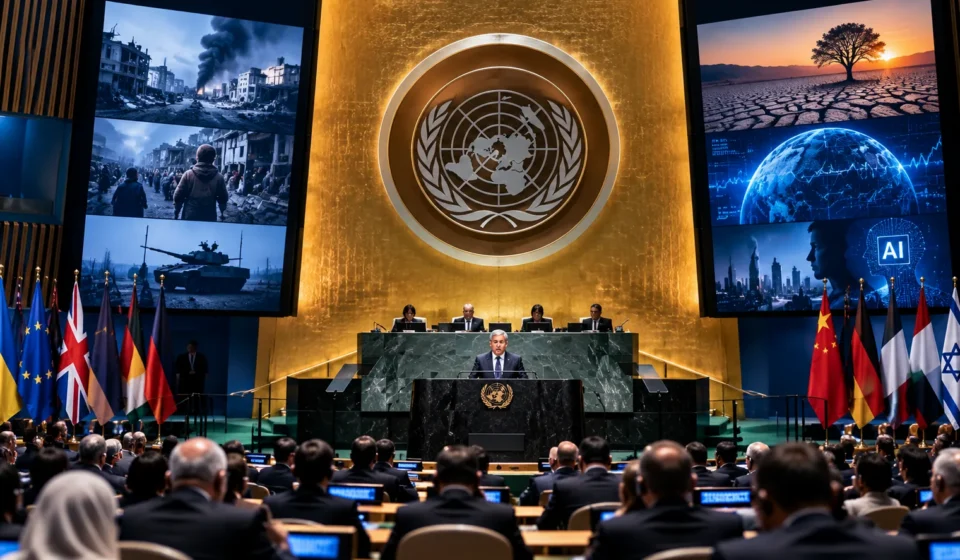

World leaders are gathering at the United Nations at a time when international cooperation is becoming harder and global risks are becoming more closely connected.
The annual UN General Assembly is once again bringing presidents, prime ministers and senior diplomats to New York, but the political environment surrounding this year’s meetings is especially tense.
Wars remain unresolved, economic pressure is affecting both developed and emerging markets, climate-related risks continue to grow, and governments are increasingly debating how artificial intelligence should be regulated.
Together, these issues are creating a more fragmented international system — and placing new pressure on the institutions designed to manage it.
A Meeting Taking Place in an Unstable World
The United Nations General Assembly has always been a platform for governments to present their priorities.
This year, however, the discussions are being shaped by a much wider sense of uncertainty.
Countries are dealing not with one major crisis, but with several at the same time.
Military conflicts are disrupting trade and energy flows. Public debt is rising in many regions. Climate events are becoming more expensive. Technology is advancing faster than regulation.
For diplomats, the challenge is no longer simply how to solve individual problems.
It is how to prevent several global risks from reinforcing each other.
Ukraine Still Shapes the Security Debate
The war in Ukraine remains one of the defining issues in international diplomacy.
The conflict continues to affect European security, defense spending, agricultural exports and energy policy.
At the United Nations, discussions around Ukraine are again focused on sovereignty, territorial integrity and the protection of civilians.
But the debate also reflects a broader divide between countries that view the war primarily as a security challenge and those that are more concerned about its economic consequences.
For many states outside Europe, the impact on food prices, fuel costs and trade remains just as important as the political dimension.
This difference in priorities helps explain why achieving a unified international position remains difficult.
The Middle East Remains Another Major Flashpoint
The Middle East is also central to this year’s diplomatic agenda.
The continuing conflict in Gaza and wider regional tensions are creating growing pressure on international institutions.
Questions surrounding civilian protection, humanitarian access and the risk of escalation remain at the center of debate.
The situation has also intensified disagreements among major powers.
Different governments continue to support different diplomatic approaches, making it difficult to build consensus on long-term solutions.
These divisions have again raised questions about whether the current structure of the UN Security Council is still capable of responding effectively to major international crises.
Pressure for UN Reform Is Increasing
The debate over reforming the United Nations has existed for years, but it is becoming more urgent.
Many countries argue that the existing system reflects the balance of power that existed after World War II rather than the political and economic structure of the modern world.
Emerging economies want a greater role in global decision-making.
African countries, in particular, continue to call for stronger representation in the Security Council.
The problem is that reform is politically difficult.
Countries with the greatest influence inside the current system are also the ones that would need to approve major changes.
As a result, discussions about reform often move much faster than actual institutional change.
Artificial Intelligence Becomes a Foreign Policy Issue
Artificial intelligence is also moving higher on the international agenda.
Until recently, AI was primarily treated as a technology and business issue.
That is changing.
Governments are now discussing AI in the context of national security, misinformation, economic competition and military applications.
Advanced AI systems could have major benefits for productivity, healthcare, education and scientific research.
But they also introduce new risks.
Countries are increasingly concerned about deepfakes, cyberattacks, automated weapons and the possibility that a small number of companies or governments could gain disproportionate control over powerful technologies.
This is pushing AI governance from national regulators into international diplomacy.
The Global Economy Adds Another Layer of Pressure
Economic uncertainty is making political tensions more difficult to manage.
Many countries are still dealing with the consequences of high inflation, elevated borrowing costs and slower economic growth.
At the same time, governments are becoming more cautious about global supply chains.
The assumption that companies should always source goods from the cheapest supplier is being challenged by concerns about security and resilience.
As a result, companies are increasingly diversifying production and governments are encouraging investment closer to home.
This trend could reduce dependence on individual countries, but it may also make global trade less efficient and more expensive.
Climate Change Is Becoming a Financial Issue
Climate change remains one of the most important long-term challenges facing the international community.
But the debate is increasingly moving beyond environmental policy.
Climate risks now affect public finances, insurance markets, food production and infrastructure investment.
Extreme weather can create billions of dollars in damage.
Rising sea levels threaten coastal cities and small island states.
Changes in rainfall can affect agriculture and food security.
For governments, the question is no longer only how to reduce emissions.
It is also how to pay for adaptation.
Developing countries continue to argue that wealthier economies should provide more financial support for climate resilience.
This remains one of the most difficult issues in international climate negotiations.
Private Meetings May Matter More Than Public Speeches
The General Assembly is known for high-profile speeches.
But some of the most important diplomacy happens outside the main hall.
Leaders hold bilateral meetings, informal discussions and closed-door negotiations throughout the week.
These conversations rarely produce immediate public results.
However, they can be important for maintaining communication between governments that otherwise have limited direct contact.
In periods of geopolitical tension, even small diplomatic channels can reduce the risk of misunderstanding.
That makes the UN gathering one of the few places where competing powers can still communicate face to face.
The World Is Becoming More Multipolar
One of the clearest trends visible at this year’s meetings is the shift toward a more multipolar international system.
The United States, China and the European Union remain major centers of economic and political influence.
But other countries are also becoming more important.
India, Gulf states, Brazil, Türkiye and other emerging powers are playing larger roles in trade, diplomacy and regional security.
This makes global decision-making more complex.
There are now more influential actors with different priorities.
The result is a world where alliances can change depending on the issue.
A country may cooperate with one group on trade, another on security and a third on energy.
Can the UN Still Deliver Results?
The growing number of crises has raised new questions about the effectiveness of the United Nations.
Critics argue that the organization often struggles to act when major powers disagree.
The Security Council can become blocked.
Resolutions may have limited enforcement mechanisms.
Diplomatic negotiations can continue for years without producing solutions.
But supporters of the UN point to another function.
Even when it cannot solve a conflict, the organization provides a place where governments can continue talking.
That role becomes more important when relations between major powers deteriorate.
Without institutions like the UN, many countries would have fewer opportunities for direct diplomatic contact.
A Test for International Cooperation
The current General Assembly illustrates a difficult reality.
The world needs more cooperation at the same time that political trust is declining.
Climate change cannot be addressed by one country.
Artificial intelligence cannot be governed effectively by one regulator.
Global trade depends on cooperation between dozens of economies.
Wars can create economic consequences far beyond the countries directly involved.
Yet governments are increasingly focused on national security, economic independence and strategic competition.
This tension is likely to shape global politics for years.
Why the UN Meeting Still Matters
The UN General Assembly will not resolve every major international crisis.
That is not what makes the meeting important.
Its value lies in maintaining a global forum at a time when political divisions are widening.
Leaders can present their positions publicly while negotiating privately.
Countries that disagree on major issues can still maintain communication.
And smaller states can participate in discussions that might otherwise be dominated by the world’s largest powers.
In an increasingly fragmented world, that function remains significant.
The central challenge facing the international community is becoming clearer.
Global problems are becoming more connected.
But the political system for solving them is becoming more divided.
How governments manage that contradiction may determine the direction of global stability in the years ahead.