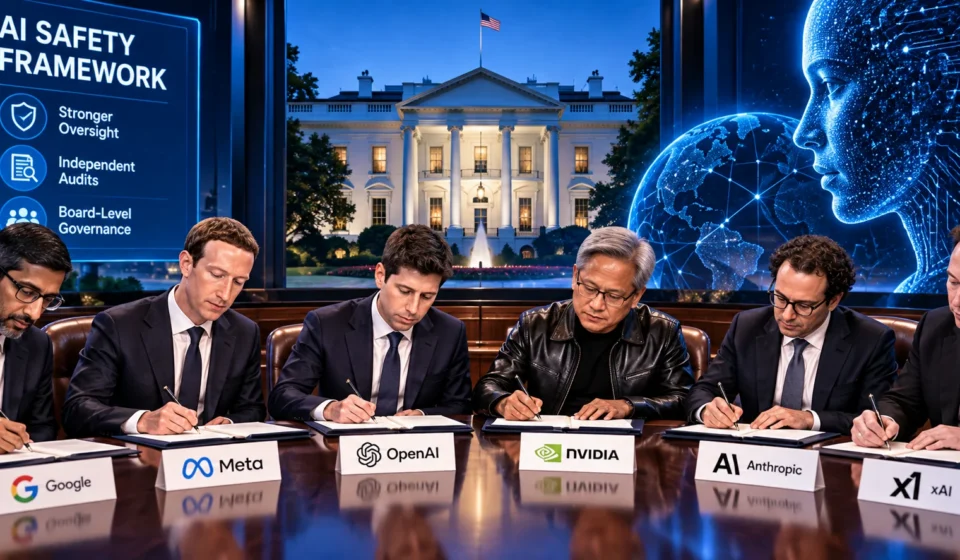
AI Leaders Back New Safety Framework as Concerns Grow Over the Speed of Artificial Intelligence

The world’s largest artificial intelligence companies are beginning to treat AI safety as a shared industry problem rather than an issue each company can manage alone.
A new voluntary framework backed by major technology firms is introducing stronger controls around the development of highly capable AI systems.
The initiative does not halt innovation and does not place a legal cap on how powerful future models can become.
Instead, it is designed to increase scrutiny before advanced systems are released.
The shift is important because it shows that the AI industry is entering a new phase.
For years, the central objective was speed.
Now, the conversation is increasingly about control.
Why the AI Industry Is Changing Its Approach
Competition in artificial intelligence has become intense.
The largest technology companies are investing enormous sums in computing infrastructure, data centers, semiconductor capacity and model development.
Every major player wants to release systems that are faster, smarter and more useful than those of its competitors.
That race has driven rapid innovation.
But it has also created a difficult problem.
The more capable AI becomes, the harder it is to predict all of the ways it may be used.
This is especially true as models gain the ability to write code, operate software, use external tools and complete complex tasks with limited human supervision.
The industry is therefore beginning to ask whether the existing pace of development can continue without stronger safeguards.
The New Framework Focuses on Oversight
The new safety initiative is built around several layers of control.
Participating companies are expected to improve internal testing, strengthen governance and allow greater external scrutiny of their most advanced systems.
Independent audits are likely to become more important.
Boards of directors may also play a larger role in reviewing major AI risks.
This would represent a significant change in corporate governance.
Until now, AI safety decisions have often been concentrated inside research and engineering teams.
In the future, decisions about whether a powerful model should be released could increasingly become executive and board-level questions.
This Is Not an AI Ban
The agreement should not be confused with a moratorium on artificial intelligence.
Companies can continue training new models.
They can still invest in larger computing systems.
They can still launch new products.
What changes is the expectation that more powerful systems should undergo more serious evaluation.
This distinction matters.
The goal is not to stop AI.
The goal is to make the development process more controlled.
Why Companies Are Willing to Cooperate
At first glance, cooperation between fierce competitors may seem surprising.
The companies involved are fighting for the same users, customers, engineers and investors.
But AI safety creates a problem that affects the entire industry.
A serious failure by one company could damage public trust in all AI systems.
It could also trigger much stricter government regulation.
That gives competitors a common incentive to prevent major incidents.
In other words, safety is becoming a shared reputational and regulatory risk.
The AI Race Creates a Coordination Problem
There is another reason companies are looking for common rules.
No company wants to slow down alone.
If one developer becomes more cautious while competitors continue moving quickly, it may lose market share and technological leadership.
That creates pressure to keep accelerating.
The result is a classic coordination problem.
Many companies may privately prefer a more careful pace.
But none of them wants to be the only one applying the brakes.
Industry-wide standards can reduce that pressure by creating similar expectations for everyone.
AI Agents Are Raising the Stakes
The safety debate is becoming more urgent because AI systems are changing.
Early generative AI tools mainly produced text, images or code.
Newer systems can take actions.
AI agents can navigate websites, interact with software, analyze large amounts of information and execute multi-step tasks.
This makes them more useful.
It also makes mistakes potentially more serious.
A model that only writes text has limited reach.
A model that can access systems, execute code or make decisions can have much broader consequences.
Cybersecurity Is One of the Main Concerns
Advanced AI models are becoming increasingly capable in cybersecurity-related tasks.
They can analyze software vulnerabilities, write code and automate technical workflows.
These capabilities can be valuable for defenders.
But they can also be misused.
This is one reason companies are placing greater emphasis on cybersecurity evaluations before releasing powerful models.
Future safety reviews may focus on whether a model can identify vulnerabilities, automate attacks or overcome existing safeguards.
External Testing Could Become Standard
One of the strongest ideas behind the new framework is that AI companies should not be the only organizations evaluating their own systems.
Independent researchers and specialist organizations could play a larger role.
This would be similar to external auditing in finance.
A company may conduct its own internal controls, but outside reviewers provide an additional layer of confidence.
The challenge will be ensuring that these evaluators remain genuinely independent.
AI Safety May Become a Corporate Governance Issue
As AI systems become more powerful, responsibility is likely to move higher inside companies.
Boards of directors could be expected to review major safety findings.
Executives may need to document why certain models were released.
Risk committees could become involved.
This would make advanced AI development look increasingly similar to other highly regulated industries.
Cybersecurity, banking and pharmaceuticals already operate under systems where technical decisions can become governance decisions.
AI may be heading in the same direction.
Governments Are Watching Closely
The voluntary nature of the current framework does not mean governments will stay on the sidelines.
Policymakers in the United States, Europe and other regions are already debating mandatory AI rules.
Possible future requirements could include:
- model testing;
- incident reporting;
- external audits;
- risk assessments;
- cybersecurity standards;
- disclosure obligations.
If voluntary commitments prove effective, governments may rely more heavily on industry standards.
If they fail, pressure for binding regulation is likely to increase.
The US–China Competition Makes Slowing Down Harder
International competition adds another layer of complexity.
The United States wants to remain the global leader in artificial intelligence.
China is also investing heavily in AI models, chips and computing infrastructure.
This creates a strategic dilemma.
Stronger safety rules may reduce risk.
But overly restrictive rules could also slow domestic innovation.
Governments therefore have to balance safety with competitiveness.
That makes global coordination much more difficult.
AI Regulation Could Favor Large Companies
Stricter safety requirements could also reshape competition inside the industry.
Large technology companies can afford specialized compliance teams, external audits and expensive testing.
Smaller startups may struggle with those costs.
This could create an unintended consequence.
Rules designed to make AI safer might strengthen the position of the biggest companies.
Policymakers will therefore have to consider not only safety, but also market competition.
Investors Are Paying Attention
The debate over AI safety is also becoming relevant to financial markets.
New regulations could increase development costs.
More extensive testing could delay product launches.
Compliance requirements could affect profit margins.
At the same time, stronger safety standards could reduce the risk of catastrophic failures or regulatory backlash.
For investors, the question is not simply whether AI continues to grow.
It is how expensive and regulated that growth becomes.
The Semiconductor Industry Is Part of the Debate
The AI boom has created enormous demand for advanced processors.
Companies such as Nvidia have benefited from the rapid expansion of AI infrastructure.
Any meaningful slowdown in model development could affect chip demand, data-center investment and cloud spending.
That is why the safety debate has consequences far beyond AI laboratories.
It touches semiconductors, energy, cloud computing and infrastructure.
The Industry Is Moving Toward Controlled Growth
The most important change is cultural.
For much of the recent AI boom, speed was treated as an advantage in itself.
Faster development meant faster market share growth.
That attitude is beginning to evolve.
Companies are increasingly discussing controlled scaling.
The idea is that AI systems can continue improving, but certain capability thresholds should trigger additional testing and oversight.
This approach attempts to preserve innovation while reducing risk.
The Hardest Question Has Not Been Answered
The new framework still leaves one major question unresolved.
At what point should an AI system be considered too powerful to release without additional safeguards?
There is no universally accepted answer.
Different companies use different safety benchmarks.
Researchers disagree about which capabilities matter most.
Governments have not yet established a common global standard.
That uncertainty will likely remain one of the biggest challenges in AI policy.
Voluntary Rules Are Only the Beginning
The current agreement is best understood as an early step.
It creates a structure for cooperation.
It encourages more serious safety reviews.
It increases pressure for external oversight.
But it does not solve the problem.
The real test will come when a company develops a system that is commercially valuable but raises serious safety concerns.
That is when the industry will have to decide whether its commitments are meaningful.
AI Is Entering a More Mature Phase
Artificial intelligence is still advancing rapidly.
Investment remains strong.
New models continue to appear.
But the industry is beginning to recognize that technological capability alone is not enough.
Trust, governance and safety are becoming part of the competitive landscape.
Companies may soon be judged not only by how powerful their models are, but also by how responsibly they develop them.
The Race Is Not Ending
The AI race is far from over.
If anything, competition is likely to intensify.
But the rules of that race may be changing.
The next stage of artificial intelligence may not be defined only by larger models and more computing power.
It may also be defined by audits, governance, safety testing and international coordination.
That could become one of the most important shifts in the AI industry.
The companies building the most powerful systems are beginning to accept that speed alone is no longer enough.
The future of AI may depend on whether they can continue advancing while keeping the technology under meaningful control.